What Is Integrated Work Delivery? How It Goes Beyond the Traditional Model
Learn what Integrated Work Delivery is and how it unifies strategy, planning, and execution to go beyond traditional work management.
What Is Integrated Work Delivery?
Integrated Work Delivery (IWD) is a connected way of managing work where planning, scheduling, capacity, execution, and reporting all operate in one unified workflow.
Instead of using separate tools for each part of the process, this method brings everything together so teams always work with the same, up-to-date information.
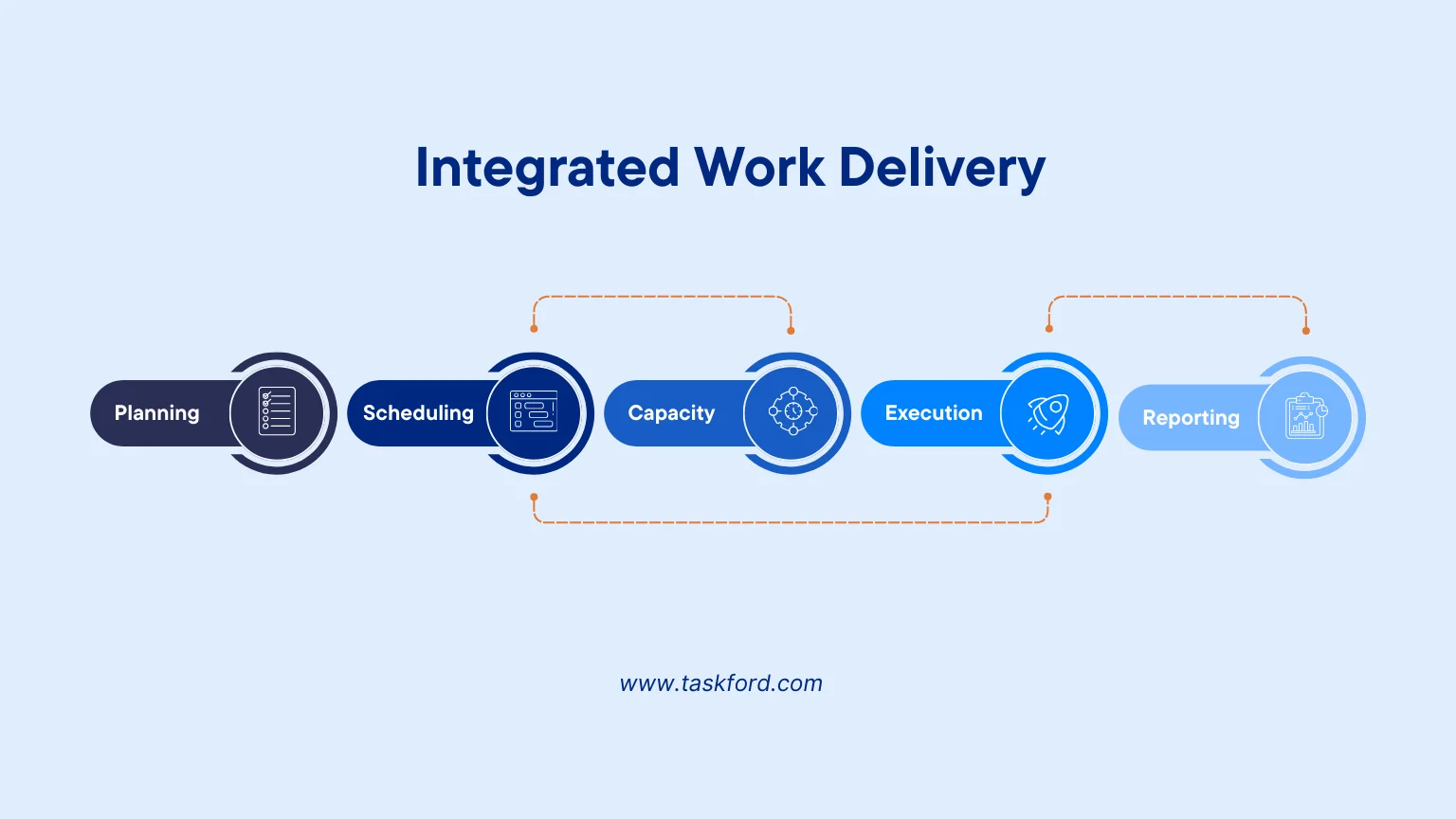
Even with many project tools, teams still struggle to deliver predictably—deadlines shift, priorities change, work sprawl grows, and leaders chase updates. This happens because strategy, plans, and daily work sit in disconnected systems.
IWD solves this by unifying the entire process. With everything connected, teams gain clarity, spot issues earlier, and deliver work more reliably.
Why Modern Teams Need Integrated Work Delivery
Modern teams struggle not because of effort, but because work is spread across disconnected tools—planning in one app, tasks in another, resources in a spreadsheet, reporting in a dashboard, and endless chats in between. Once real work starts, everything quickly falls out of sync.
Deadlines slip, priorities shift, capacity gets stretched, and teams work from different versions of the truth. These common work delivery problems come from misalignment, not incompetence.
Integrated Work Delivery fixes this by connecting strategy, planning, resources, execution, and reporting into one continuous workflow. When everything moves together, teams see what’s happening, why it’s happening, and what needs attention—early enough to act.
In a world where everything moves fast and expectations keep rising, teams don’t just need more tools. They need a connected way to deliver work reliably and consistently.
Why “Integrated”? – Traditional vs Integrated Work Delivery
To understand why “Integrated” matters, we first need to look at how most teams operate today. The issue isn’t your people – it’s the fragmented system they’re working in. When each part of delivery lives in a different tool, things fall apart the moment real work begins.
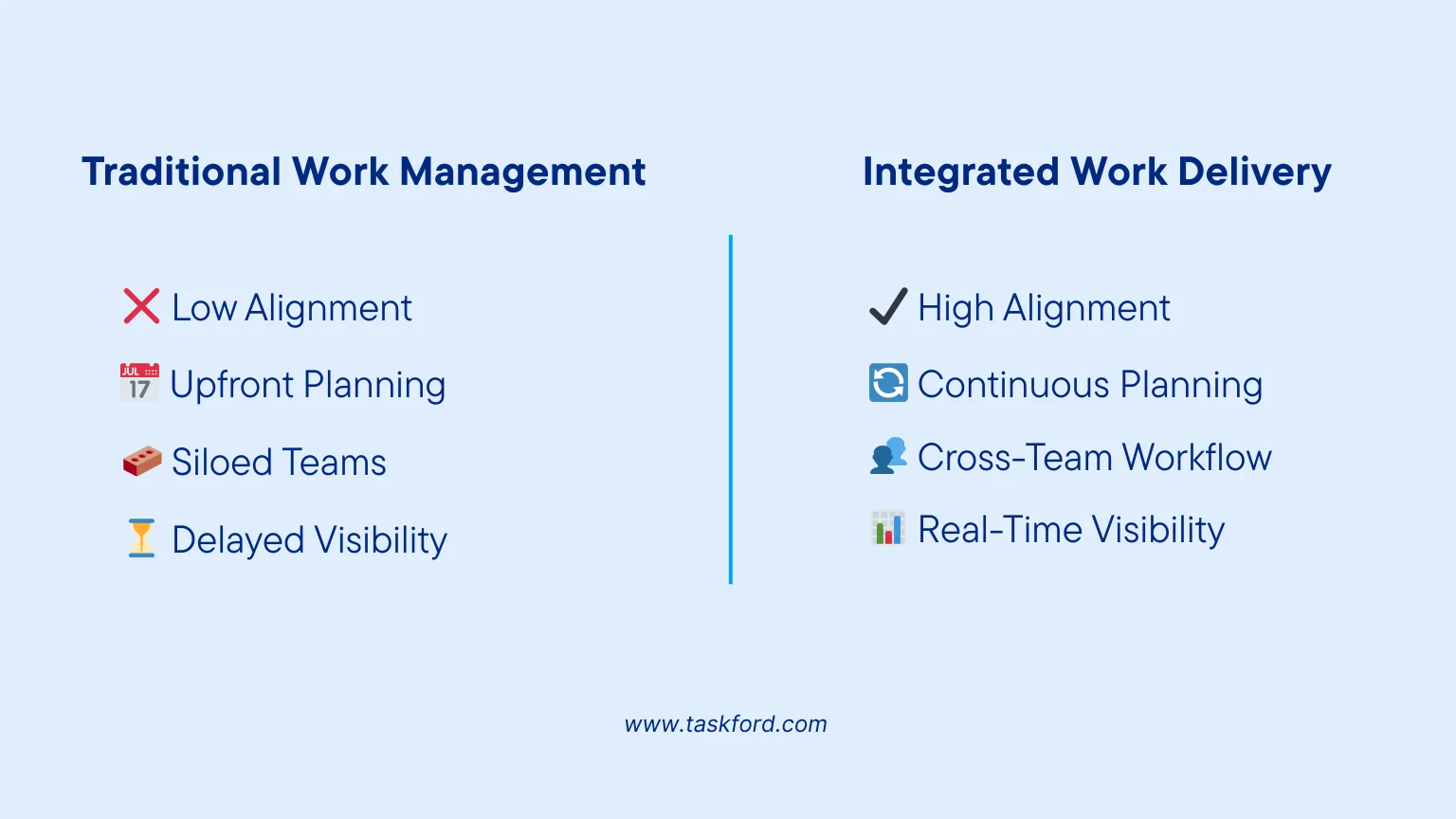
1. Traditional Work Management: Where Things Fall Apart
In the traditional model, every stage of work is managed somewhere different – strategy in one place, project plans in another, tasks in a separate app, and capacity in spreadsheets. Each tool functions well on its own, but together they create a disconnected process.
As work progresses, these pieces fall out of sync. Deadlines shift without cascading, teams update their own systems but not others, and leaders chase status because no one is looking at the same information.
This leads to issues delaying work delivery, unnecessary rework, and constant last-minute firefighting, which is a common pattern in work delivery failures.
2. Integrated Work Delivery: Where Strategy and Execution Finally Meet
Integrated Work Delivery replaces this fragmented setup with one connected workflow. Strategy flows into planning, planning reflects real capacity, execution syncs in real time, and reporting updates automatically.
When everything moves together, teams stay aligned. When data stays accurate, delivery becomes predictable.
Teams can even introduce simple work delivery rituals, such as daily check-ins or weekly planning that work because they’re tied to real-time data instead of scattered tools.
3. Traditional vs. Integrated Work Delivery (Quick Comparison)
| Aspect | Traditional Work Delivery | Integrated Work Delivery |
|---|---|---|
| Workflow | Separate tools, disconnected steps | One unified workflow |
| Data | Outdated and inconsistent | Real-time and accurate |
| Planning | Assumption-based | Capacity-based |
| Execution | Siloed teams | Aligned teams |
| Reporting | Manual and delayed | Automatic and live |
| Risk Visibility | Late | Early |
| Predictability | Low | High |
The Core Goals of Integrated Work Delivery
Integrated Work Delivery exists for one purpose: to make work predictable. But achieving predictability requires more than tracking tasks — it requires connecting every part of delivery into one coherent flow. At its core, IWD focuses on these goals:
1. Connect Strategy to Daily Work
Teams should always know why the work matters and how it ties back to broader priorities. IWD ensures that goals, plans, and execution stay aligned from start to finish.
2. Create Realistic, Capacity-Based Plans
Plans work best when they reflect the team’s actual availability. IWD helps teams build schedules and timelines that match real capacity, not assumptions.
3. Keep Everyone Working From the Same Source of Truth
Instead of juggling multiple tools, IWD centralizes information so everyone sees the latest updates, status, and changes in one place.
4. Make Delivery Predictable
Early visibility helps teams adjust with confidence, improving work delivery metrics such as throughput, cycle time, and bottleneck detection.
5. Reduce the Manual Work of Project Tracking
No more chasing updates or stitching together reports. IWD keeps progress in sync automatically, reducing overhead for both teams and leaders.
6. Connect Delivery with Cost & Financial Clarity
IWD links planned budgets to the actual work being done, helping teams compare expected vs. actual costs in real time. When spending begins to drift, teams can adjust early—before small variances turn into major overruns.
Together, these goals help teams deliver with confidence, not guesswork.
Integrated Work Delivery vs. Project Management Platforms
To understand the value of Integrated Work Delivery, it helps to compare it directly with what traditional project management platforms were designed to do — and where they fall short once real delivery begins.
Traditional project management focus on planning and organizing work. Integrated Work Delivery focuses on ensuring the work can actually be delivered predictably.
1. What Traditional Project Management Platforms Focus On
Traditional project management platforms help teams structure their work: create tasks, set timelines, track progress, and collaborate. They give teams a clear way to organize projects.
What they do well:
- Planning tasks and milestones
- Visualizing work with boards or timelines
- Tracking progress at a basic level
- Supporting team communication
Where they struggle:
- They don’t reflect real capacity (who can actually take on the work)
- They don’t adapt automatically when priorities or workloads shift
- They don’t connect strategy to execution
- They can’t show cross-team workload or conflicts
- They rely on manual updates and reporting
Traditional tools help teams set up work — but not ensure delivery stays on track.
Want a quick refresher on how traditional project management works? Explore What is Project Management?
2. What Integrated Work Delivery Brings Instead
A connected delivery system where strategy, planning, resources, capacity, time, and cost operate inside one real-time model so teams can deliver work with accuracy and predictability.
What IWD replaces or fixes in traditional tools:
| Traditional Project Management | Integrated Work Delivery | |
|---|---|---|
| Main Focus | Planning and organizing tasks | Predictable, connected delivery across teams |
| View of Capacity | Separate or missing | Built-in and real-time |
| Plan Updates | Manual and often delayed | Automatic and continuous |
| Team Alignment | Fragmented across multiple tools | One shared source of truth |
| Visibility | Limited to individual projects | Cross-team, cross-project visibility |
| Strategy Connection | Rarely connected to daily execution | Strategy flows directly into plans and work |
| Delivery Predictability | Low — plans drift once execution starts | High — risks surface early; plans stay realistic |
| End Result | Good structure but inconsistent delivery | Clear flow and predictable delivery |
Common Use Cases
Use Case 1: Cross-Functional Projects With High Coordination Needs
A product launch involving Product, Design, Engineering, QA, Marketing, and Sales. In traditional tools, each team works on its own board, making handoffs inconsistent and timelines unclear, while IWD:
- Connects plans across teams
- Shows all dependencies in one workflow
- Adjusts timelines automatically when one team falls behind
- Ensures every team knows what they’re waiting for and who’s waiting on them
This reduces misalignment and prevents delays caused by cross-team blind spots.
Use Case 2: Organizations Running Many Parallel Projects
An operations team running 12–20 internal improvement projects at the same time. Team members are shared across projects, making workload balancing difficult.
IWD provides:
- Shows each person’s total workload across all projects
- Highlights over-allocation and conflicts instantly
- Helps leaders plan realistically without overload
- Keeps each project on track by stabilizing resource allocation
Instead of guessing availability, teams have clear, connected capacity planning.
Use Case 3: Projects With Strong, Multi-Layered Dependencies
A software release requiring backend → frontend → QA → documentation → deployment steps. Traditional tools can show tasks, but not how delays ripple across the workflow.
How IWD helps:
- Maps dependencies clearly
- Automatically adjusts downstream tasks when earlier work changes
- Surfaces risks early
- Keeps the entire chain aligned
TaskFord – The #1 Integrated Work Delivery Platform
If Integrated Work Delivery is the future of how teams deliver work, TaskFord is the platform built to make that future real.
TaskFord brings the full Integrated Work Delivery approach into one simple, unified platform. It connects strategy to daily execution, helping teams plan, schedule, and deliver work across all critical projects. Instead of spreading information across multiple tools, TaskFord brings planning, resources, communication, and reporting together in one place — closing the gap between strategic goals and day-to-day work.
With a complete view of projects, workloads, and capacity, organizations can move beyond basic task tracking and achieve more predictable, confident delivery.
What TaskFord Helps Teams Achieve
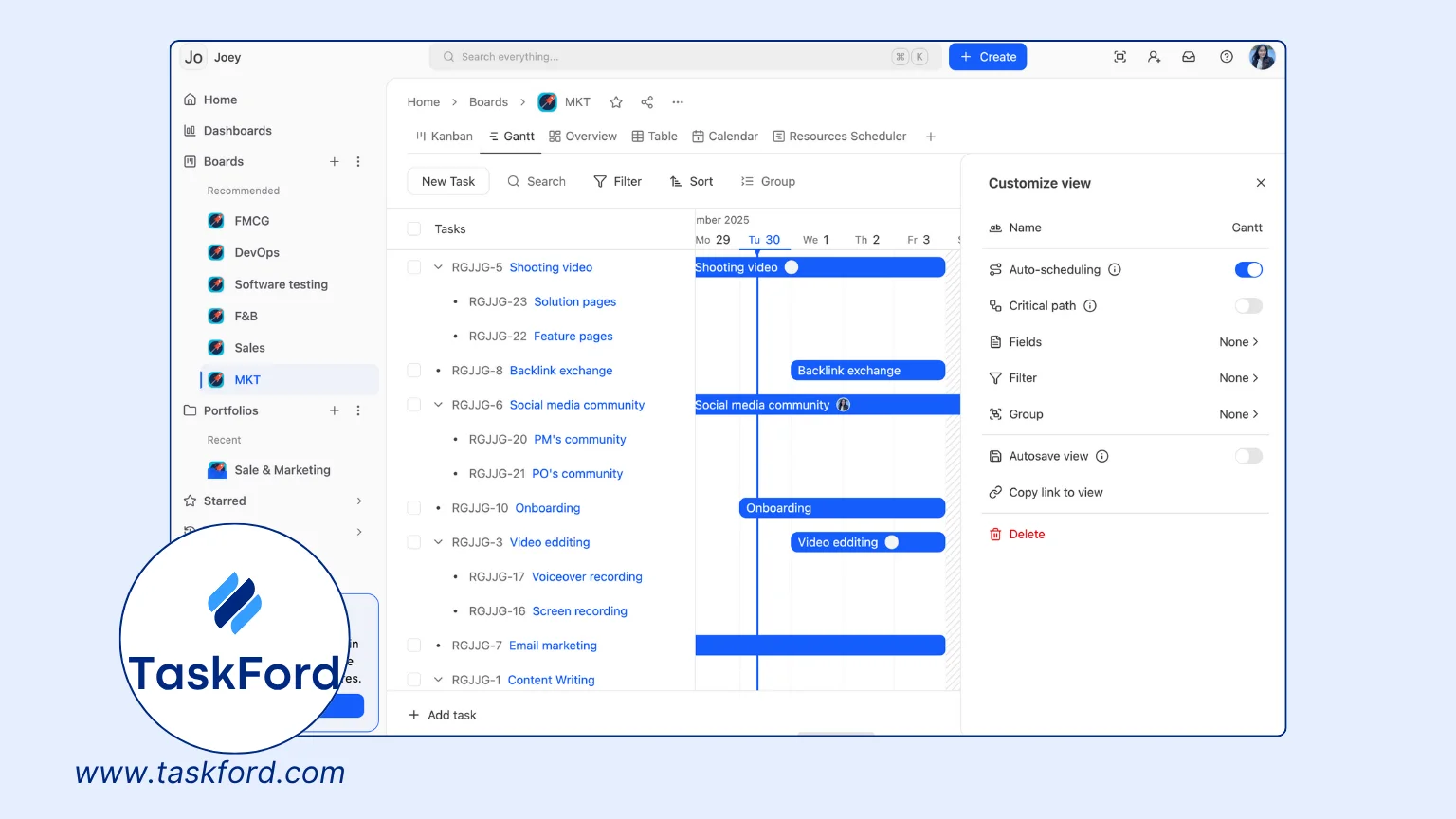
1. Project & Portfolio Management
TaskFord centralizes all projects in one easy-to-understand view. Teams see active work, upcoming initiatives, and potential risks in real time. This helps:
- Teams stay aligned on priorities
- Leaders gain visibility across the full portfolio
- Everyone understand how daily work connects back to strategic goals
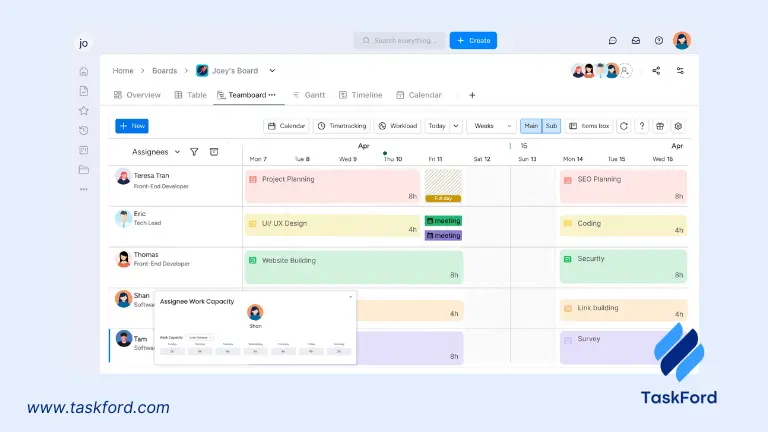
2. Resource Scheduling
TaskFord provides an accurate picture of team availability and workload. Teams can see:
- Who is available
- Who is overloaded
- Where skill gaps exist
- How work can be distributed more evenly
This enables balanced assignments, reduces burnout, and ensures the right people are working on the right things at the right time.
Read also: Workload Management - 10 Smart Ways to Keep Your Team Burnout-Free
3. Time Tracking & Delivery Accountability
Teams can log effort and compare actual time against expectations. This helps organizations:
- Improve future estimates
- Track progress more accurately
- Spot delays early
- Strengthen accountability across teams
→ See how our time tracking supports better deliver.
4. Finance & Cost Governance
TaskFord gives organizations financial clarity throughout delivery. Teams can :
- Set budgets
- Track cost and billable rates
- Monitor spending
- Forecast margins
Delivery and profitability stay connected, ensuring projects remain both successful and financially healthy.
Why Teams Choose TaskFord
- One source of truth for projects, schedules, workloads, budgets, and progress
- Works for any team size or workflow
- Real capacity awareness for smarter planning
- Simple, intuitive interface
- Predictable delivery through early risk visibility
- End-to-end support from planning → scheduling → delivering
TaskFord brings every part of work delivery together, giving teams a connected, confident, and predictable way to deliver the projects that matter most.
Final Thoughts
The more complex work becomes, the harder it is for teams to stay aligned when strategy, plans, and execution live in separate places. Missed updates, shifting priorities, and unclear capacity aren’t signs of a weak team, they’re signs of a fragmented system.
Integrated Work Delivery offers a clearer path forward. By connecting every stage of work into one continuous workflow, it removes the gaps that create confusion and delays. Teams gain a shared understanding of what’s happening, what’s changing, and what needs attention before issues turn into missed deadlines.
As organizations aim for more predictable, efficient, and transparent delivery, one thing becomes clear:
Integration isn’t an advantage – it’s becoming the new standard for how modern teams get work done.
Subscribe for Expert Tips
Unlock expert insights and stay ahead with TaskFord. Sign up now to receive valuable tips, strategies, and updates directly in your inbox.