How WBS Reveals Delivery Breakdown Before It’s Too Late
Learn how a work breakdown structure in project management reveals delivery risks, clarifies deliverables and ownership, and supports work delivery for teams.
A few weeks into a project, everything usually looks fine. Tasks are moving, people are busy, and updates sound positive. But later, when the deadline gets closer, someone asks a simple question: “Are we actually done with this part?”
I’ve seen this happen many times. The work is happening, but the final pieces aren’t clear. Some deliverables are only half done. Some were never clearly defined. And fixing those gaps late in the project is stressful for everyone.
This is exactly the kind of problem a Work Breakdown Structure helps with. By breaking work into clear deliverables, WBS makes it easier to see what’s missing early, before small gaps turn into big delivery issues.
What Is a Work Breakdown Structure in Project Management?
You may know work breakdown structure (WBS) as a method for breaking work into smaller pieces, but it’s often used in the wrong way.
- A WBS is not a task list.
- It is not a schedule or a Gantt chart.
- And it does not explain how or when work will be done.
A WBS is a deliverable-based breakdown of scope. It defines what must be delivered by decomposing project outcomes into smaller, clear components. Each level of the WBS represents a clearer definition of the final result.
This focus on outcomes is what makes WBS valuable beyond planning. By defining scope in terms of deliverables, teams gain a concrete reference for what completion actually means.
How a Work Breakdown Structure Reveals Delivery Breakdown Early
A WBS does more than organize work. It exposes structural weaknesses in delivery that are otherwise easy to miss.
1. Hidden Work That Only Appears When It Is Already Blocking Delivery
When teams break deliverables down properly, missing work often surfaces. Reviews, security checks, testing, approvals, data migration, and handovers frequently appear late because they were never made explicit.
If this work only becomes visible during execution, delivery risk already exists. The WBS reveals this risk early by forcing teams to ask whether all required outcomes are actually defined.
2. Dependencies That Are Discovered Too Late
Without a WBS, dependencies often live in conversations or assumptions. Teams only realize one piece of work blocks another when progress stalls.
By structuring work around deliverables, dependencies become visible earlier. When tasks cannot be logically sequenced without overlap or conflict, it signals that delivery plans are fragile.
These late discoveries often create cascading delays, where a small dependency slip affects multiple downstream deliverables.
3. Progress Looks Healthy, but Deliverables Do Not Move
A common sign of delivery breakdown is high activity with little completion. Tasks are marked “in progress” or “done,” yet milestones remain untouched.
A WBS ties tasks directly to deliverables. When deliverables are not advancing despite constant activity, the disconnect becomes obvious. This prevents teams from mistaking motion for progress.
4. Underestimated Scope Creates Mid-Project Surprises
Incomplete breakdown leads to assumptions. Supporting work, rework, coordination effort, and integration tasks emerge after timelines are committed. Teams are forced to choose between extending timelines, increasing effort, or cutting quality.
These surprises are not execution failures. They are signs that scope was never fully understood. A WBS surfaces this uncertainty early, before commitments harden.
5. No Clear Signal of What Actually Puts Delivery at Risk
When scope is unclear, teams cannot tell which work is critical. Everything feels urgent, yet nothing is clearly decisive.
A WBS clarifies which deliverables truly drive completion. If those elements are unstable, delivery risk is already present, regardless of reported progress.
In this sense, a WBS functions as a visibility and risk-detection tool, not just a planning artifact.
How to Use WBS to Detect Delivery Breakdown Early
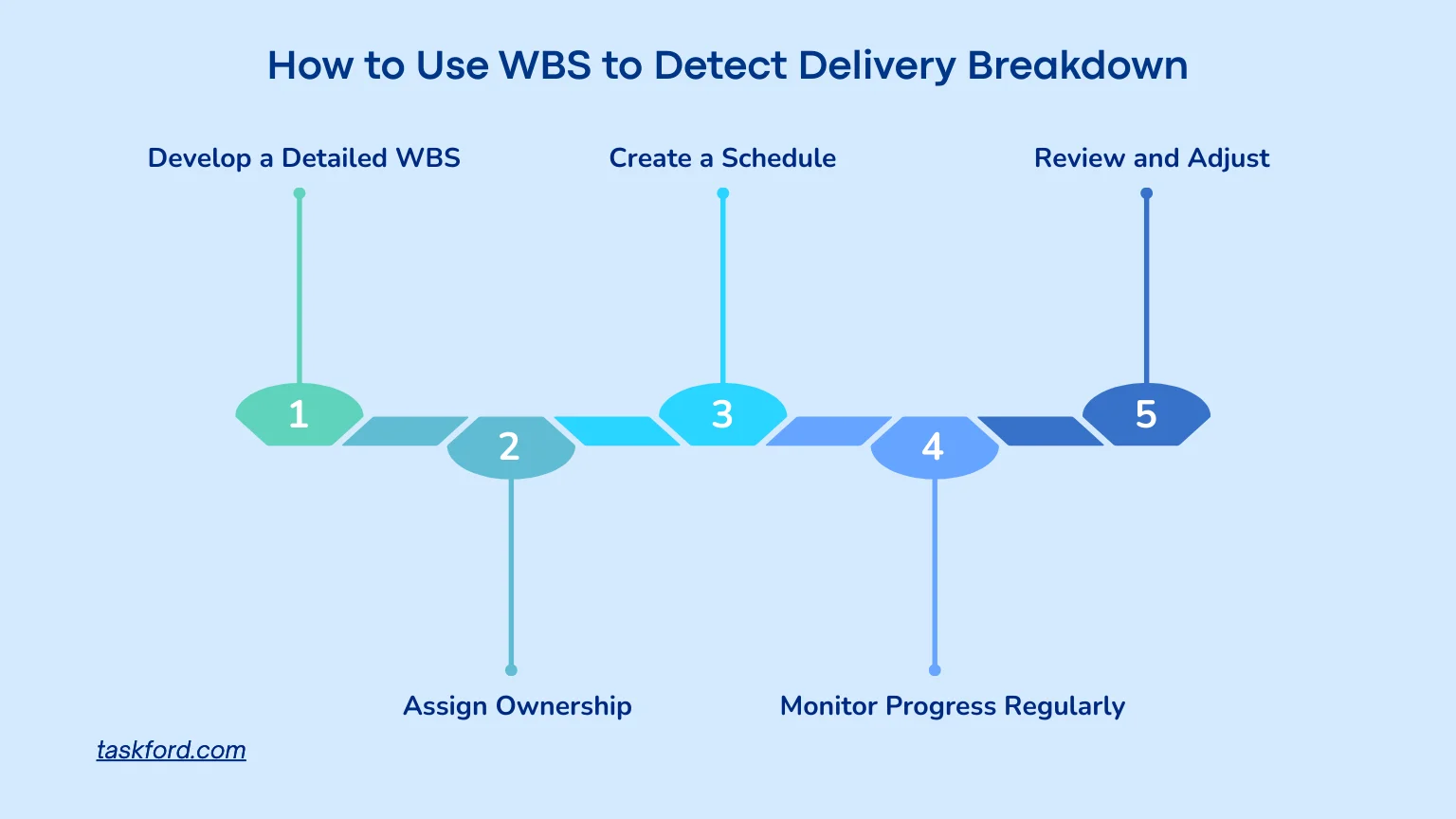
Step 1: Develop a Detailed WBS
Start from the final outcome and break work down hierarchically into deliverables, not tasks. Each level (deliverables and work packages) should represent a clearer definition of what must be produced.
Break down work until each work package can be estimated, assigned to one owner, and completed without ambiguity.
Example: Website Launch WBS
1.0 Website Launch (Final Deliverable)
- 1.1 Design (Major Deliverable)
- 1.1.1 Page Design (Sub-Deliverable)
- 1.1.1.1 Homepage Design (Work Package)
- 1.1.1.1.1 Approved Homepage Layout (Completion Criteria)
Then the next major deliverable:
- 1.2 Content (Major Deliverable)
- 1.2.1 Product Content (Sub-Deliverable)
- 1.2.1.1 Product Page Copy (Work Package)
- 1.2.1.1.1 Approved Product Text (Completion Criteria)
If a work package does not clearly define a deliverable or cannot be owned by one person, it needs further breakdown. However, if you have mastered and known clearly what should be done, multi-level breakdown will only become optional.
Step 2: Assign Ownership
For each work package, assign exactly one owner. This person is responsible for completion, not just contribution.
Ownership should sit as close to execution as possible. Avoid assigning ownership at a high level where accountability becomes unclear.
Example:
“Design homepage” → UI designer
“Write product copy” → Content lead
If ownership is unclear, delays are guaranteed even if everyone is busy.
Step 3: Create a Schedule
- List all work packages from the WBS: Use only the work packages already defined. If new work appears here, the WBS is incomplete and should be revised first.
- Identify dependencies between work packages: Determine what must finish before another package can start. Do not assume parallel work without confirming real constraints.
- Sequence the work: Order work packages based on their dependencies to reflect how delivery will actually unfold, not how it is hoped to unfold.
- Group work packages into milestones: Combine related work into milestones that represent meaningful delivery points, not just calendar checkpoints.
- Visualize the schedule: Use a Gantt chart or its dependency view to make sequencing and blocking relationships visible. This is where unrealistic timelines and hidden risks usually surface.
This step often exposes unrealistic assumptions. Work that looks parallel turns out to be sequential. Critical dependencies appear only when they are made explicit.
Step 4: Monitor Progress Regularly
Review progress based on completed work packages and deliverables, not activity or time spent. Ask two questions in every review:
– What work packages are finished?
– What is preventing the next ones from finishing?
When teams focus only on tasks “in progress,” delivery can look healthy while nothing actually finishes.
Step 5: Review and Adjust the Baseline
As execution begins, teams inevitably learn more about scope, effort, and dependencies. When this happens, the WBS and schedule baseline should be reviewed and adjusted deliberately.
Updating the baseline early is a sign of control, not failure. It allows teams to reset expectations while options still exist, instead of reacting later under deadline pressure when trade-offs become costly and forced.
How to Apply WBS in TaskFord
TaskFord, an integrated work delivery platform, helps teams apply WBS in real work, not just in planning. It keeps deliverables, ownership, and dependencies visible during execution, so delivery breakdown is easier to detect early.
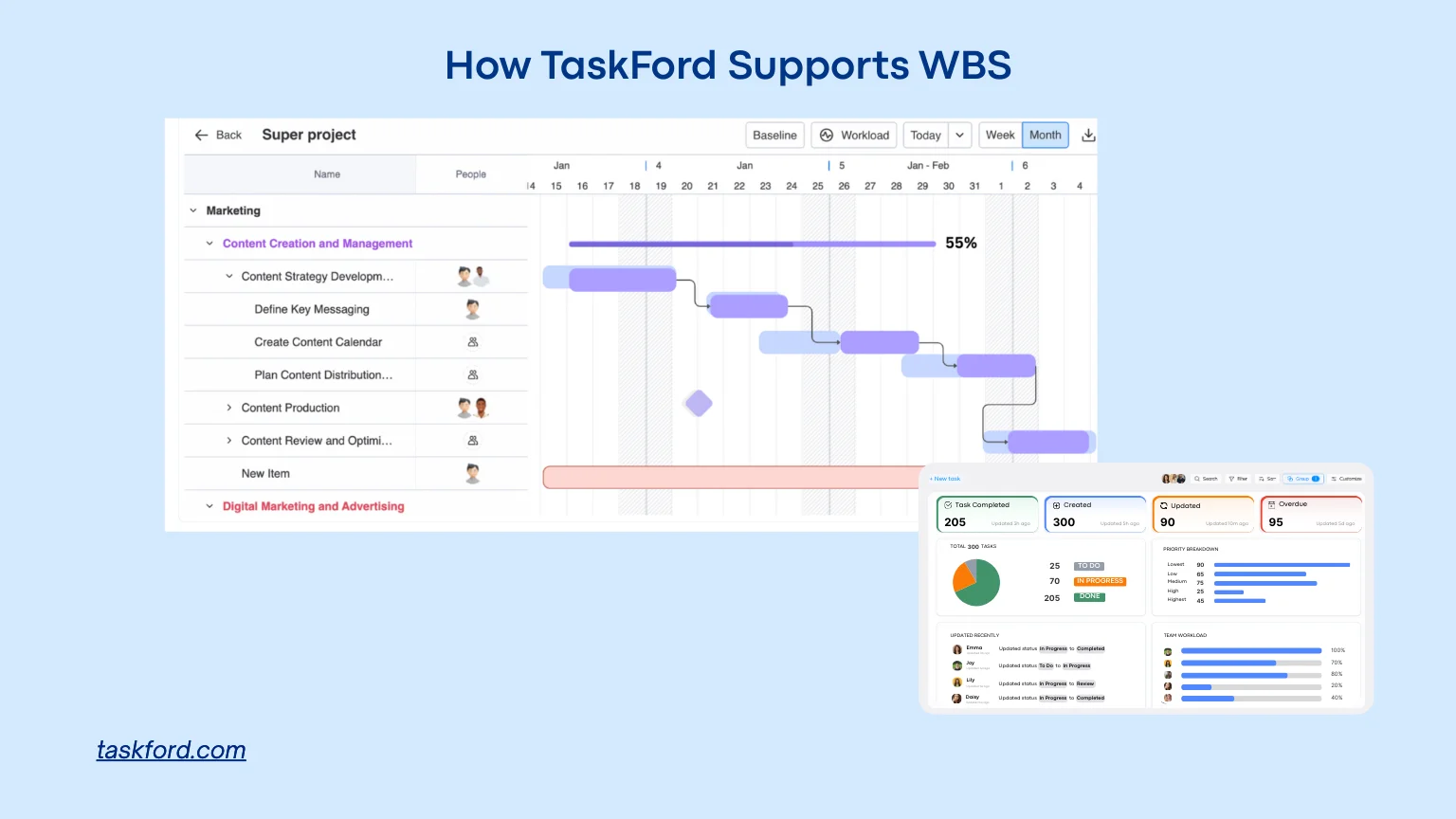
Here are the features that support WBS-based delivery visibility in TaskFord:
- WBS Gantt chart: Connect WBS to the Gantt Chart. Supports the WBS by visualizing task hierarchy, milestones, dependencies, baseline and task ownership in one view, so teams can see how responsibility and progress at the work-package level impact overall delivery and identify sequencing or ownership risks early.
- Progress Tracking: Track progress by work package, not just by individual tasks. Helping teams notice delays or missing work before they impact delivery.
- Reporting: Helps teams spot false progress when work is moving but outcomes are not.
What makes TaskFord different:
Traditional project management tools spread delivery context across multiple views and reports. However, unlike them, an integrated work delivery platform like TaskFord brings deliverables, tasks, ownership, dependencies, timelines, and progress into a single, connected space. This allows teams to see how daily work ties directly to outcomes without switching tools or reconciling updates, making delivery risks easier to spot early and act on.
Practical Tips for Using WBS Without Slowing Teams Down
Many teams resist WBS because it feels like extra work that does not help delivery. This usually happens when WBS is treated as documentation instead of a way to think through the work.
To keep WBS useful:
- Break work down only as far as needed to plan and estimate
- Focus on clear deliverables and ownership, not perfect structure
- Update the breakdown when scope or understanding changes
- Use the WBS to support decisions, not to maintain a document
- Review the WBS during delivery check-ins, not just at planning time or milestone reviews, so emerging risks are discussed while there is still room to adjust.
A simple WBS that reflects reality helps teams deliver. A detailed one that only exists on paper does not.
Tips for Using WBS in Project Management Without Slowing Teams Down
Many teams resist WBS because it feels like extra work that does not help delivery. This usually happens when WBS is treated as documentation instead of a way to think through the work.
To keep WBS useful:
- Break work down only as far as needed to plan and estimate
- Focus on clear deliverables and ownership, not perfect structure
- Update the breakdown when scope or understanding changes
- Use the WBS to support decisions, not to maintain a document
A simple WBS that reflects reality helps teams deliver. A detailed one that only exists on paper does not.
Conclusion
Delivery breakdown does not start with missed deadlines. It begins with unclear work, assumed ownership, and hidden dependencies. A work breakdown structure in project management helps surface these issues early by making work visible at the level where delivery actually happens. It turns vague plans into explicit commitments that teams can act on.
Used as part of integrated work delivery and supported by tools like TaskFord, WBS becomes more than a planning technique. It becomes a way to protect execution, trust, and outcomes. The earlier teams are willing to see reality, the more control they retain over delivery.
Subscribe for Expert Tips
Unlock expert insights and stay ahead with TaskFord. Sign up now to receive valuable tips, strategies, and updates directly in your inbox.