Project Cost Tracking: What It Is and How to Do It Right
Discover actionable strategies and tools for mastering project cost management through effective cost tracking, ensuring financial control and project success.
Project cost management is the foundation of successful project delivery, ensuring financial discipline, resource efficiency, and alignment with organizational objectives. At its heart, project cost tracking provides the real-time visibility needed to control expenses and achieve project goals.
This comprehensive guide explores project cost management, with a focus on cost tracking as a critical component. We offer actionable strategies, tangible tools, and real-world insights to help project managers, finance teams, and business owners maintain financial control, prevent budget overruns, and drive long-term success, drawing from proven cost management principles.
Understanding Project Cost Management and Project Cost Tracking
Project cost management involves planning, estimating, budgeting, and controlling costs to complete a project within its approved budget. It encompasses four key processes: cost estimation, budgeting, monitoring, and control.
Project cost tracking, a vital element, focuses on monitoring expenses for labor, materials, equipment, and overhead, comparing them to the budget, and adjusting to prevent overspending. Unlike cost estimation, which sets the financial baseline during planning, cost tracking is an ongoing activity that delivers real-time financial insights.
For example, a healthcare project upgrading patient systems might estimate costs for IT staff, software licenses, and hardware, then track these expenses to ensure they align with the budget. By integrating cost tracking into cost management, teams can detect issues early, optimize resources, and ensure projects meet financial, quality, and timeline targets. This synergy supports informed decision-making and enhances project outcomes across industries.
Why Project Cost Tracking Matters
Effective project cost tracking is essential to project cost management, directly impacting financial performance and organizational success. Without robust tracking, projects risk budget overruns, delayed deliverables, or reduced profitability. Here are key reasons why cost tracking is critical:
- Prevents Budget Overruns: Real-time monitoring identifies cost overruns early, enabling timely interventions to stay within budget.
- Optimizes Resource Efficiency: Tracking ensures labor, materials, and equipment are used effectively, maximizing value and minimizing waste.
- Enhances Financial Forecasting: Historical cost data from tracked projects improves budgeting accuracy for future initiatives.
- Supports Strategic Decision-Making: Cost insights guide actions like reallocating funds, renegotiating contracts, or adjusting project scope.
- Aligns with Organizational Goals: Effective tracking ensures projects contribute to financial stability and long-term business growth.
By embedding cost tracking within cost management, businesses maintain financial discipline, avoid surprises, and position projects as drivers of organizational success. For instance, a logistics firm tracking fuel costs can adjust delivery routes to save thousands, aligning with broader cost-saving goals.
Key Elements of Effective Project Cost Tracking
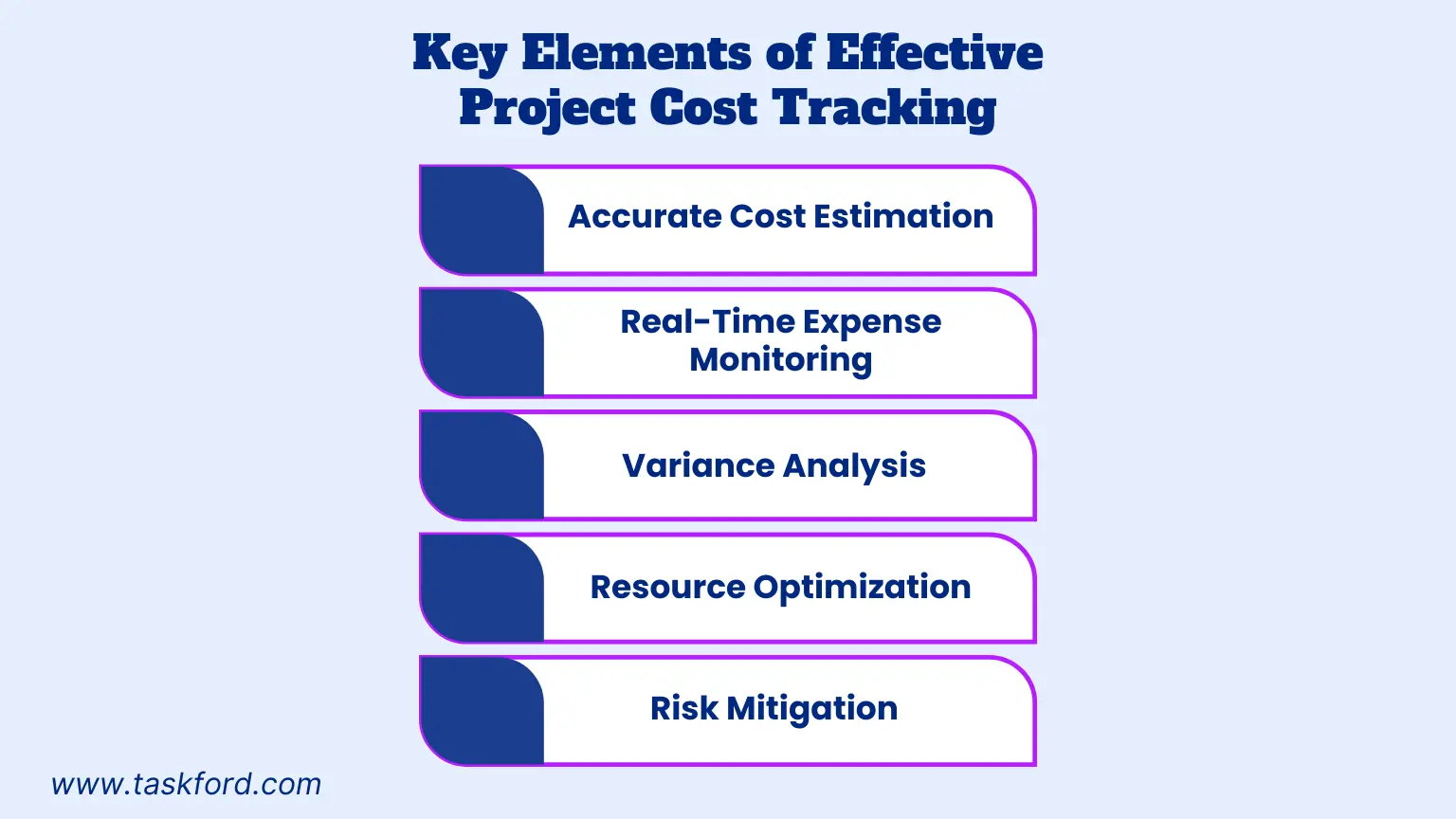
1. Accurate Cost Estimation
Cost tracking begins with precise estimation, breaking down projects into tasks and forecasting costs for labor, materials, equipment, and overhead. Techniques like analogous estimation (using historical data), bottom-up estimation (task-level costing), and parametric estimation (statistical models) ensure accuracy. For example, a logistics project might budget $250,000, including $100,000 for labor and $80,000 for fuel. Accurate estimates provide a reliable baseline for tracking.
2. Real-Time Expense Monitoring
Continuous monitoring captures costs as they occur, such as employee hours, vendor invoices, or equipment rentals. Tools that log hours or categorize expenses offer real-time visibility, enabling project managers to address issues promptly and maintain budget alignment.
3. Variance Analysis
Comparing actual costs to the budget, known as variance analysis, reveals discrepancies. For instance, if software costs exceed projections, analysis identifies the cause, such as licensing fees, enabling corrective action. Visual reports and dashboards enhance this process by highlighting trends and anomalies.
4. Resource Optimization
Cost tracking involves optimizing resource use. By analyzing data, project managers can identify inefficiencies, such as underutilized staff or equipment, and reallocate resources to maximize value without compromising quality or timelines.
5. Risk Mitigation
Unforeseen risks, like market price fluctuations or scope creep, can disrupt budgets. A robust tracking system includes contingency reserves and regular risk assessments to manage unexpected costs, ensuring projects stay on track.
How to Do Project Cost Tracking the Right Way
To integrate cost tracking into project cost management, follow this eight-part guide, which combines practical actions with strategic approaches to ensure financial control and alignment with organizational objectives. This process incorporates cost management principles (estimation, budgeting, monitoring, and control) tailored to effective cost tracking.
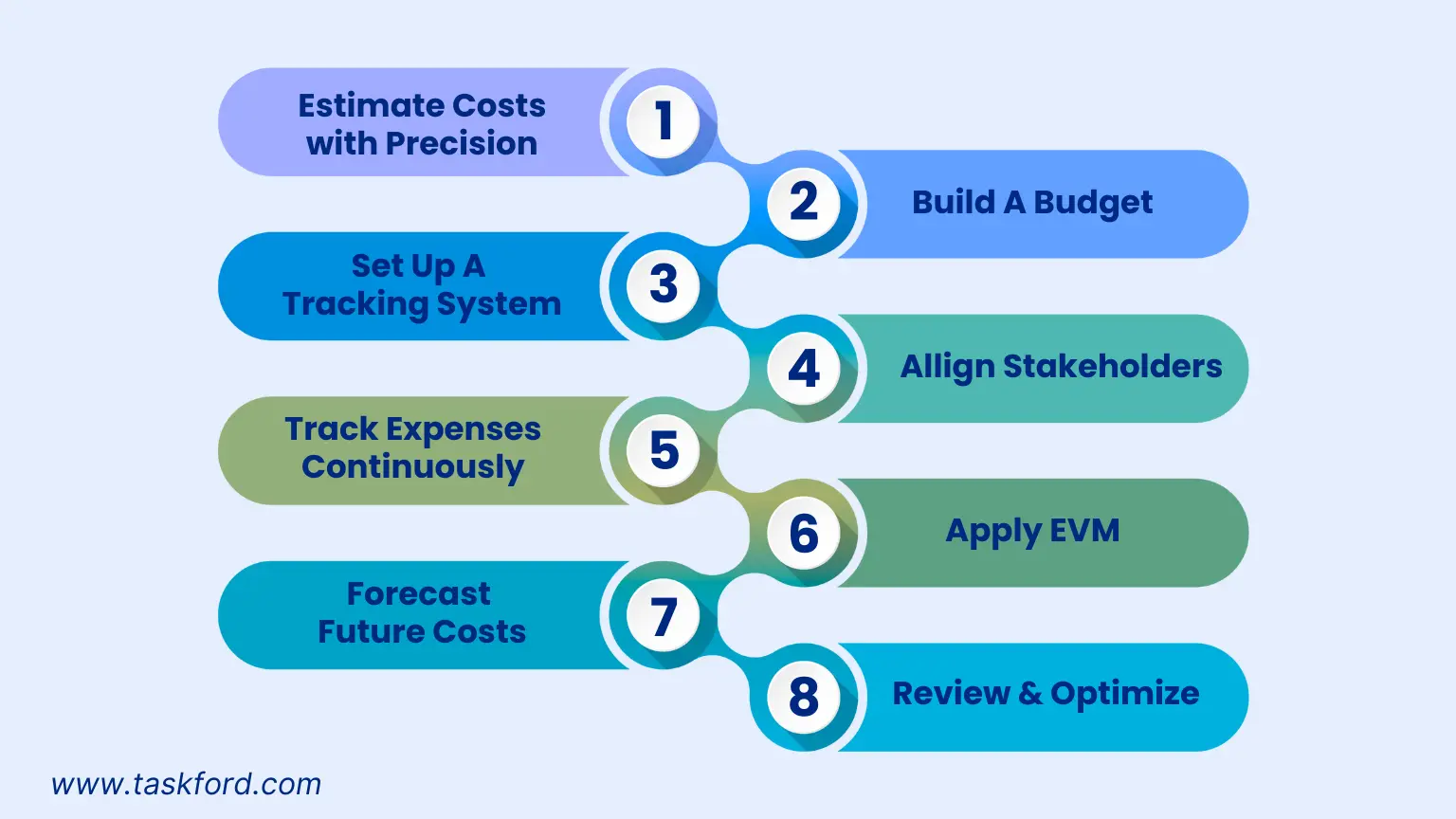
Step 1: Estimate Costs with Precision
Accurate estimation sets the foundation for effective cost tracking. Use proven methods to create a detailed cost baseline that guides all future monitoring and control.
Techniques to use:
- Analogous estimation: Use historical data from similar projects.
- Bottom-up estimation: Calculate costs at the task level and sum them for a full project view.
- Parametric estimation: Apply statistical models (e.g., cost per labor hour or material unit).
Example: A healthcare project upgrading its patient system estimates $400,000 total, including:
- $200,000 for IT staff
- $120,000 for software
- $50,000 for hardware
- $30,000 for overhead
Pro tip: Always validate estimates with stakeholders (finance, clients, and team leads) to ensure they’re realistic and fully supported.
Step 2: Build a Budget with Contingency Reserves
Once costs are estimated, organize them into a project budget, your benchmark for tracking and performance assessment.
Steps to build your budget:
- Allocate costs to specific tasks or deliverables.
- Include contingency reserves (10–15%) to cover unexpected risks such as price fluctuations or minor scope changes.
- Document budget assumptions clearly for transparency.
Example: A logistics project with a $300,000 base budget adds a $30,000 contingency reserve to prepare for potential fuel price increases.
Pro tip: A well-structured budget doesn’t just prevent overspending, it empowers proactive decision-making when change occurs.
Step 3: Set Up a Real-Time Tracking System
Modern cost tracking relies on automation and integration. Manual spreadsheets invite errors, while digital systems provide real-time visibility.
What to look for in your system:
- Automated expense categorization (labor, materials, equipment)
- time tracking features to calculate labor costs
- Budget alerts when spending nears thresholds
Example: Using project management software, you can monitor daily expenses across departments and detect anomalies instantly rather than waiting for end-of-month reports.
Step 4: Align Stakeholders with Cost Goals
Involve team members, clients, and finance teams in tracking processes to ensure alignment. Share weekly or biweekly cost reports to maintain transparency. For example, presenting variance reports to a client during a healthcare project can facilitate discussions about scope adjustments, enhancing cost control and stakeholder trust.
Step 5: Track Expenses Continuously
Log costs as they occur like daily labor hours, material invoices, or equipment rentals to maintain accuracy. For instance, a logistics project might track fuel costs weekly to detect market-driven increases early. Continuous tracking ensures data is current, enabling proactive decision-making to prevent budget overruns.
Step 6: Apply Earned Value Management (EVM)
Earned Value Management (EVM) bridges the gap between budgeted plans and actual performance, offering a data-driven view of progress.
Core EVM metrics:
- Cost Variance (CV): Earned Value – Actual Cost → Measures whether you’re over or under budget.
- Schedule Performance Index (SPI): Earned Value / Planned Value → Indicates how efficiently time is being used.
Example: If a healthcare project shows a negative CV of $12,000, it means spending has exceeded earned value. The project manager can cut consulting hours or renegotiate supplier terms to regain balance.
Pro tip: EVM provides quantitative control, it’s your best early-warning system for financial trouble.
Step 7: Forecast Future Costs
Analyze current cost trends to predict future expenses and adjust plans proactively. For instance, if a project’s labor costs are 10% above budget, forecast the impact through completion and reallocate staff or renegotiate contracts to avoid overruns. Forecasting aligns cost tracking with long-term cost management goals, ensuring financial predictability.
Step 8: Review and Optimize Across Projects
Conduct regular financial reviews to audit expenses, assess tracking effectiveness, and identify cross-project efficiencies. For example, analyzing labor costs across multiple projects might reveal opportunities to reallocate staff, reducing overtime expenses. Reviews involve stakeholders to align tracking with organizational financial strategies, ensuring continuous improvement in cost management.
How TaskFord Enhances Project Cost Tracking
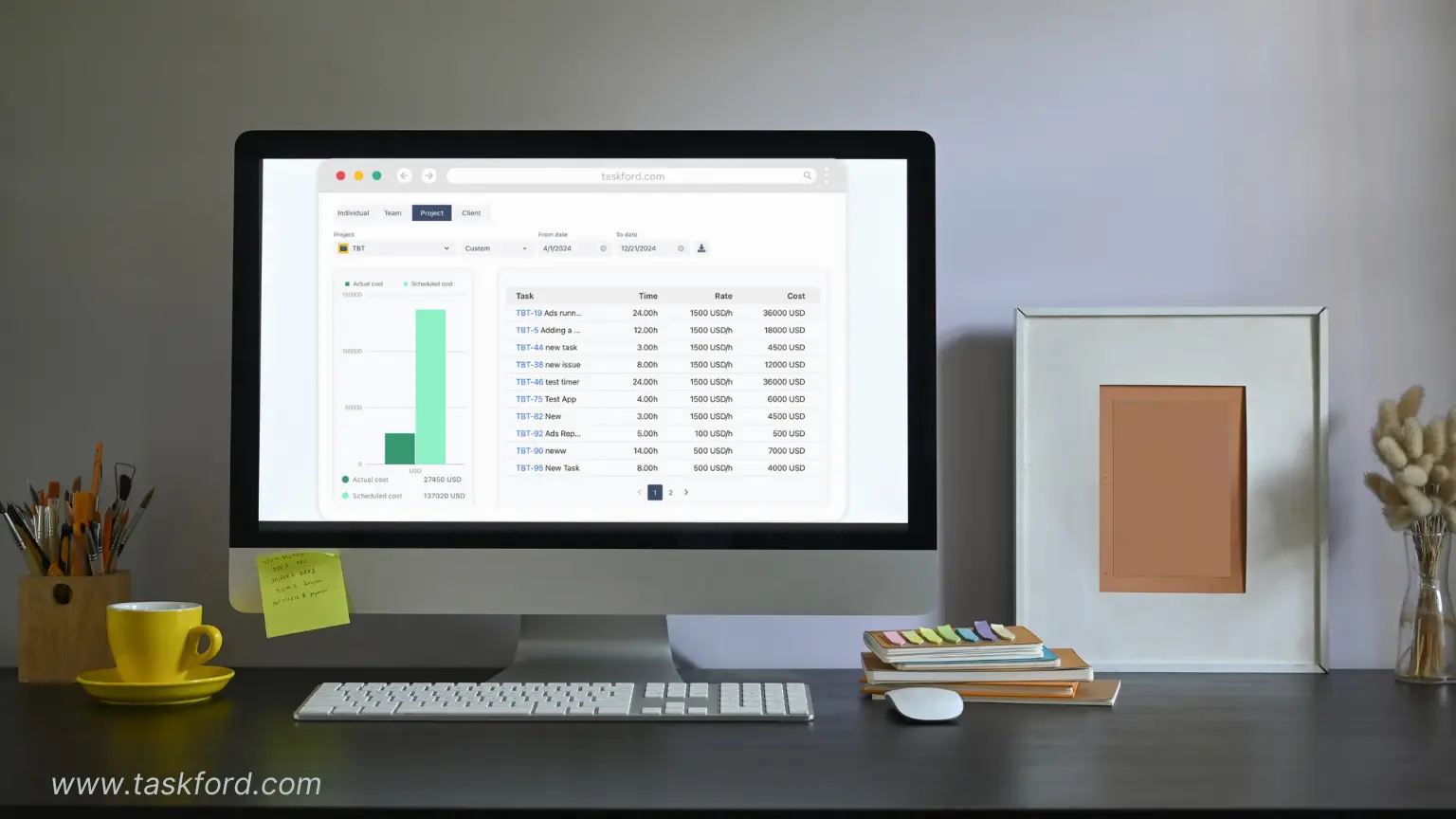
As a comprehensive project management and resource planning platform, TaskFord supports cost tracking within project cost management, offering tailored features to simplify financial oversight:
- Task Management: Assign tasks and track progress to align labor costs with project goals.
- Time Management: Log hours to calculate labor costs, automatically syncing with the budget.
- Resource Management: Allocate tasks based on team skills and availability to optimize resources.
- Budget Monitoring: Track actual versus planned costs with real-time alerts to prevent overruns.
- Reporting and Dashboards: Generate reports and visualize cost trends for quick insights.
- Gantt Charts: Plan tasks and align costs with project milestones for better control.
TaskFord’s cost management tools empower teams to manage costs effectively, reduce financial risks, and deliver projects on budget, aligning with industry best practices.
Real-World Applications of Project Cost Tracking
These two scenarios illustrate how cost tracking drives project success within cost management:
Scenario 1: Healthcare System Upgrade
A hospital upgrades its patient management system with a $450,000 budget. Using EVM, the project manager identifies a negative Cost Variance of $15,000 due to extended software testing caused by compatibility issues. By prioritizing critical features and reducing testing scope, the team saves $20,000, realigning the project with the budget. Regular stakeholder reports ensure client approval for scope changes, maintaining trust and financial control.
Scenario 2: Logistics Optimization
A logistics firm implements a new delivery system, budgeting $280,000. Real-time tracking reveals fuel costs exceeding projections by $10,000 due to rising market prices. By forecasting future expenses and optimizing delivery routes using data analytics, the team saves $12,000, keeping the project within budget. Cross-project analysis identifies similar savings opportunities for future initiatives, enhancing organizational efficiency.
Best Practices for Ongoing Cost Management
To sustain effective cost tracking and management, consider these best practices:
- Set Measurable Financial Goals: Define clear, quantifiable budget targets for each project to guide tracking efforts.
- Engage Stakeholders Regularly: Share cost updates to ensure alignment and facilitate collaborative decision-making.
- Update Budgets Dynamically: Adjust budgets to reflect changes in scope, resources, or market conditions.
- Train Teams on Cost Tools: Build skills in cost management and tracking software to enhance accuracy and accountability.
- Leverage Advanced Technology: Use platforms with EVM and forecasting capabilities to improve financial oversight.
Conclusion
Project cost management, powered by effective cost tracking, enables teams to deliver projects on budget while supporting organizational growth. By implementing a structured cost tracking process that integrates estimation, budgeting, monitoring, and control, businesses achieve financial clarity and control. These practices ensure success. With TaskFord’s tools, teams can master project cost tracking, align with strategic goals, and drive lasting financial success.
Learn more
- Project Cost Management 101- Beginner Guide to Budgeting and Control
- How To Master Cost Tracking: A Step-by-Step Guide to Effective Project Cost Management
- 10 Leading Project Management Tools for Remote Teams - Expert Reviews 2025
Subscribe for Expert Tips
Unlock expert insights and stay ahead with TaskFord. Sign up now to receive valuable tips, strategies, and updates directly in your inbox.