How Product Teams Use MoSCoW Prioritization to Build Better Roadmaps
Discover how to prioritize tasks using the MoSCoW method. Learn to categorize Must-Haves, Should-Haves, Could-Haves, and Won’t-Haves for better focus.
If you’ve ever worked on a product team, you know the struggle: too many ideas, not enough time, and everyone thinking their request is the top priority. It’s easy for roadmaps to get messy and planning sessions to turn into endless debates.
The MoSCoW prioritization method offers a way out of that cycle. It’s a straightforward method that helps teams cut through the noise and determine what truly needs to happen first. No complicated formulas, just a clear structure for making smarter decisions.
In this blog, we’ll explain what MoSCoW is, how it works, and how real product teams use it to build clearer, more focused roadmaps. Let’s dive in.
What Is MoSCoW Prioritization?
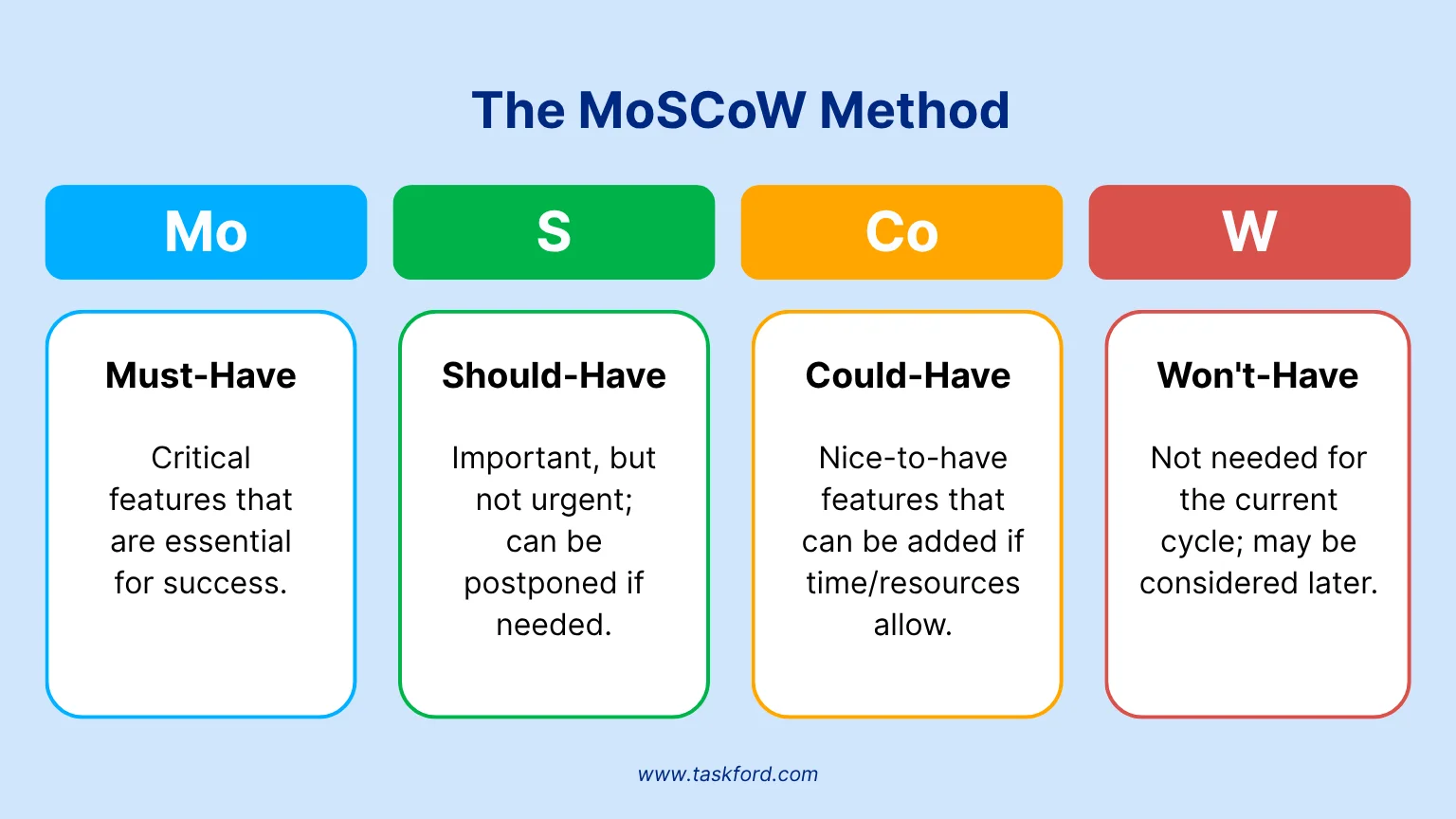
MoSCoW prioritization is a simple yet powerful method for helping teams decide which tasks or features are most important. The name MoSCoW is an acronym that stands for:
- Must-Have: These are the non-negotiable features or tasks that absolutely need to be included. Without them, the project or product won’t succeed.
- Should-Have: Important but not critical. These are things that add value and improve the product, but can be postponed if necessary.
- Could-Have: Nice-to-have features that aren’t essential. These can be added if there’s time or resources left.
- Won’t-Have (for now): Items that are not needed for the current cycle. They might be revisited later, but aren’t a priority right now.
The MoSCoW method is widely used in agile environments, especially during roadmap planning or backlog grooming. It helps teams focus on what truly matters, avoid scope creep, and ensure that resources are spent on what will have the biggest impact.
A Brief History of the MoSCoW Method
The MoSCoW method was created by Dai Clegg in the early 1990s during his time at Oracle UK Consulting. It was introduced as part of the Dynamic Systems Development Method (DSDM), an early agile framework that eventually became a key part of Agile project management.
Clegg designed MoSCoW to be a simple and easy way for teams to prioritize project requirements. The method helped teams focus on the most important tasks while still leaving room for flexibility as project needs changed. Over time, the method proved successful beyond software development and was adopted in many other industries to help manage all types of projects.
Today, the MoSCoW method remains a popular tool for prioritization, helping teams stay focused on what matters most and deliver projects on time and within budget.
The MoSCoW Rules
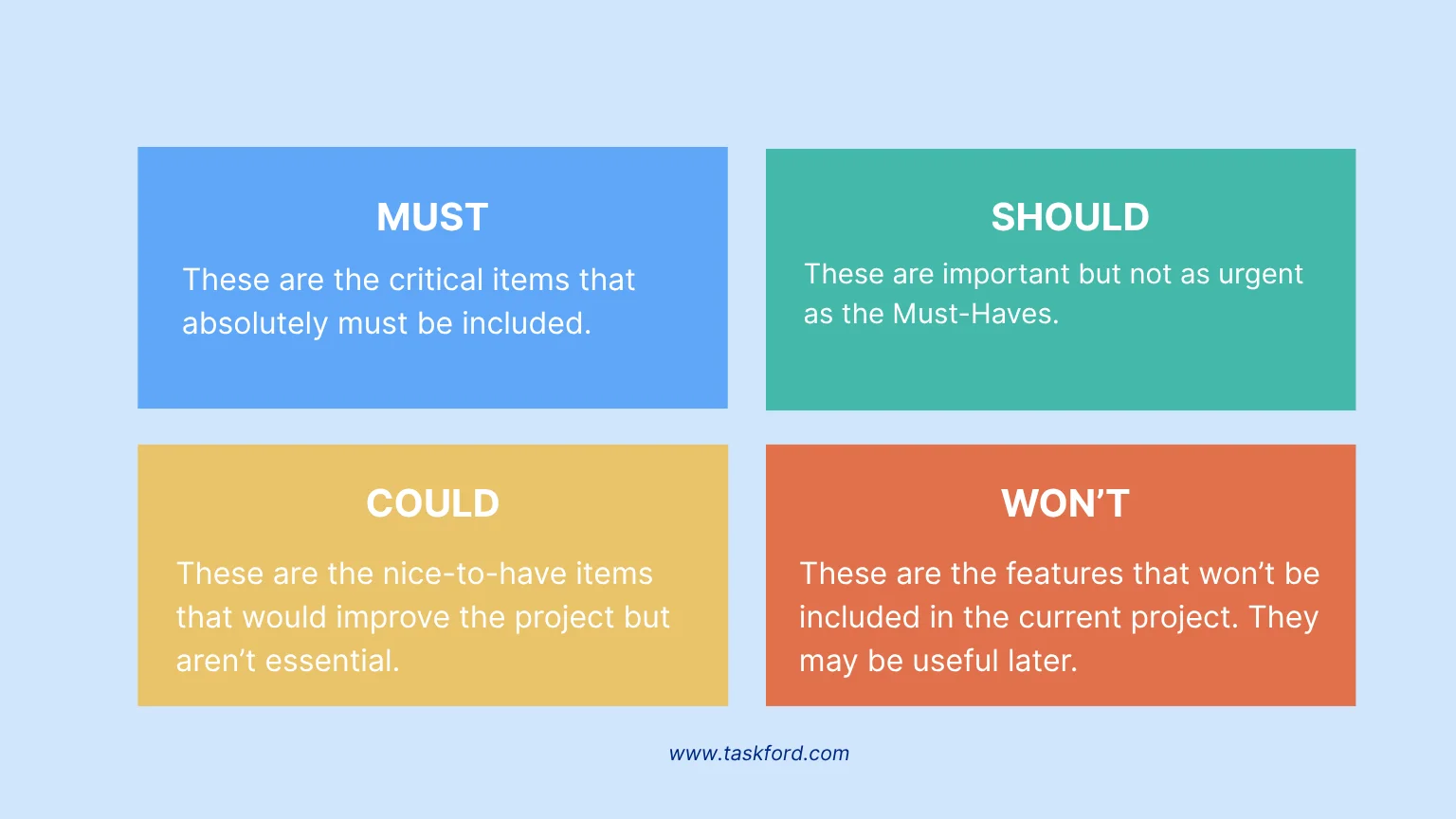
The MoSCoW prioritisation uses four simple categories to help teams prioritize their tasks or features. Here’s a breakdown of the rules for each:
1. Must-Have
These are the critical items that absolutely must be included. If they’re missing, the project won’t succeed. Think of them as the bare minimum for success. For example, a key feature that’s required to meet the project’s main goals.
2. Should-Have
These are important but not as urgent as the Must-Haves. You should include them, but the project can still move forward without them. These features add extra value but can be postponed if necessary, such as a nice design upgrade or an additional feature that improves user experience.
3. Could-Have
These are the nice-to-have items that would improve the project but aren’t essential. If you run out of time or resources, these can be left out without affecting the project’s success. Examples include a bonus feature that would be great but isn’t critical to the core function of the product.
4. Won’t Have (for now)
These are the features that won’t be included in the current project. They may be useful later but aren’t needed right now. This category helps avoid scope creep (when projects get bigger than planned) and keeps the focus on the most important tasks. For example, a feature that can be added in future updates.
By using this method, teams can clearly see what needs immediate attention and what can wait. It helps keep everyone aligned on priorities, ensuring that resources are focused on what will make the biggest impact.
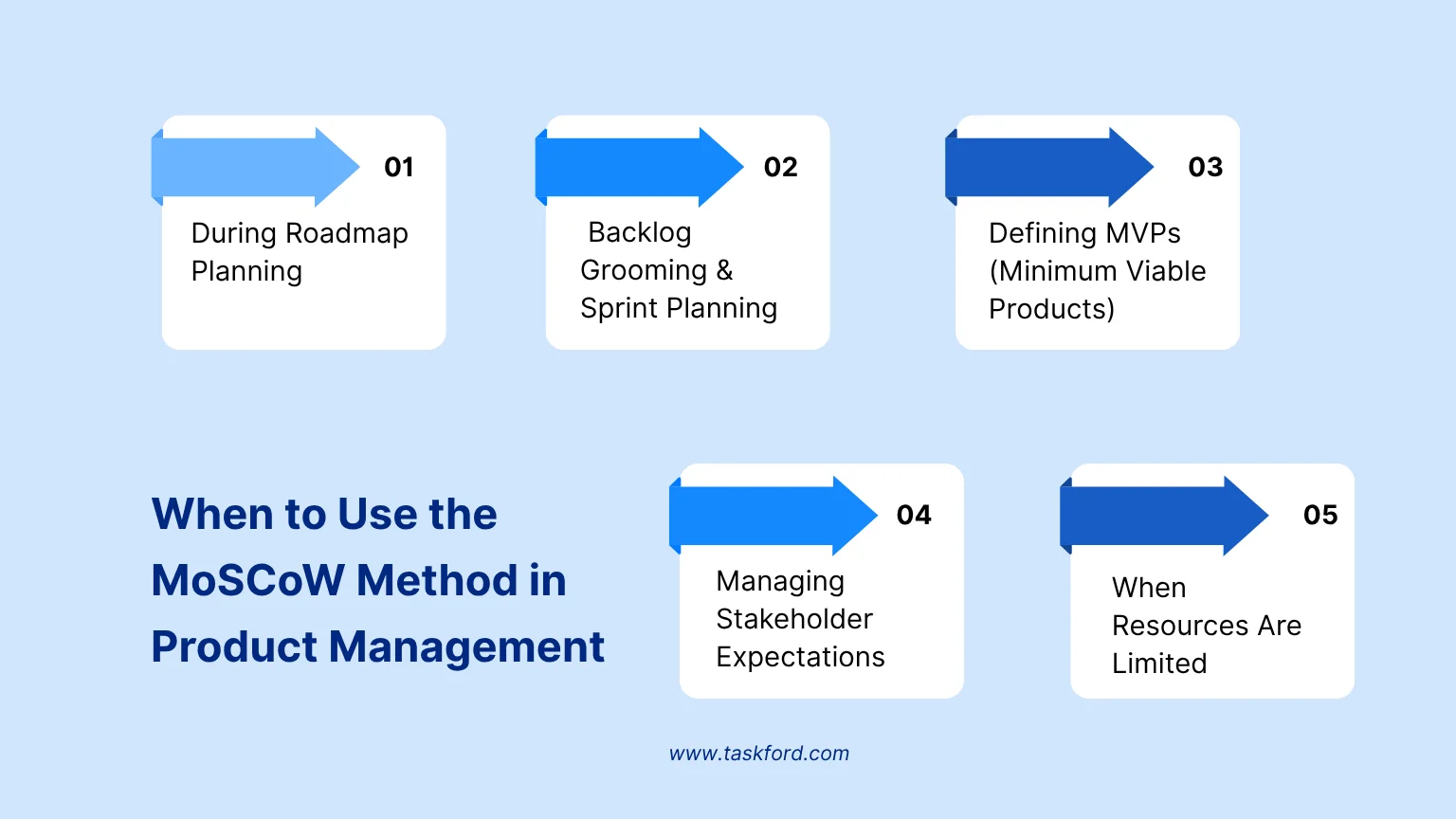
When to Use the MoSCoW Method in Product Management
The method is a versatile tool that helps product teams prioritize effectively. It’s especially useful in situations where you need to make tough decisions about which tasks, features, or requirements to focus on.
1. During Roadmap Planning
When planning your project roadmap, there’s often a long list of features and ideas. The method helps you identify which features are absolutely essential (Must-Haves), which are important (Should-Haves), and which can be added later (Could-Haves). It ensures you create a realistic and focused plan.
2. Backlog Grooming & Sprint Planning
In agile development, you regularly revisit your backlog to decide what to work on next. MoSCoW is perfect for backlog grooming and sprint planning because it helps prioritize tasks based on urgency and impact. It ensures that your team works on the most important tasks first, without getting overwhelmed by too many competing priorities.
3. Defining MVPs (Minimum Viable Products)
For MVPs, you need to focus on the most critical features that make the product functional. MoSCoW helps identify the Must-Haves for your MVP, ensuring you don’t waste resources on features that aren’t essential for your initial launch.
4. Managing Stakeholder Expectations
When stakeholders have conflicting priorities, the method provides a clear way to discuss what will and won’t be included in a project or release. It makes it easier to communicate decisions and manage expectations, reducing the risk of scope creep and misunderstandings.
5. When Resources Are Limited
In situations where time, budget, or team capacity is limited, prioritization helps make the best use of available resources. It ensures that your team works on the highest-priority tasks, delivering the most value without spreading resources too thin.
How Product Teams Apply MoSCoW Prioritization in Practice
The MoSCoW method provides a structured way to prioritize tasks, features, and requirements. Here’s how product teams can apply it step by step:
Step 1: Define the Scope and Objectives
Before diving into feature categorization, it’s essential to understand the product’s broader goals. For instance, you can use the OKR (Objectives and Key Results) framework to set clear objectives and measurable outcomes. This helps ensure that your priorities align with business goals.
For example:
- Objective: Improve user retention
- Key Result 1: Increase the 30-day retention rate by 15%
- Key Result 2: Reduce churn by 10% over the next quarter
- Objective: Enhance the onboarding experience
- Key Result 1: Achieve a 90% completion rate for new user sign-ups
- Key Result 2: Decrease time to first value by 20%
These OKRs guide the team on where to focus, ensuring that the most important features and tasks contribute directly to improving product engagement, retention, and user experience.
Step 2: Gather Requirements
Collect input from stakeholders, users, and technical teams to identify the key features and needs, for example, the project management app:
Functional requirements might include:
- Task creation and assignment
- Gantt chart and project timelines
- File sharing and collaboration tools
- Integration with other apps (e.g., Slack, Google Drive)
Non-functional requirements could focus on:
- System performance and speed
- Security (e.g., encryption, authentication)
- Scalability for growing teams
- Mobile access
Gathering these requirements ensures that you’re aligned on what needs to be built before moving forward.
Step 3: Categorize using the MoSCoW technique
Once the requirements are gathered, sort each item into the four MoSCoW categories. This helps the team clearly see what needs immediate attention and what can wait.
- Must-Have: Essential features the product cannot launch without. Example: Task creation, user authentication, basic project dashboard.
- Should-Have: Important features that add value but aren’t critical for the first release. Example: File sharing, due date reminders.
- Could-Have: Nice-to-have features that improve the experience but can be postponed if time or resources are limited. Example: Custom themes, advanced reporting.
- Won’t-Have (for now): Features that are not needed in this release and can be revisited later. Example: Built-in video conferencing, complex automation workflows.
Categorizing your list this way ensures the team focuses on the highest-impact work and avoids overloading the initial release.
Step 4: Align with stakeholders
After the requirements are categorized, review the prioritized list with key project stakeholders—such as product managers, team leads, and business owners. Walk through each MoSCoW category to confirm that everyone agrees on what’s essential for the upcoming release and what can wait.
This step is about making sure expectations are clear. It’s the moment to address any concerns, clarify trade-offs, and adjust priorities if needed. When stakeholders are aligned early, it reduces misunderstandings later and keeps the team focused on delivering the features that matter most.
Step 5: Execute and Monitor Progress
With priorities agreed on, the team can begin building the Must-Have and Should-Have items. Break these into manageable tasks, assign owners, and set realistic timelines.
Use project management tools to track progress, identify bottlenecks, and ensure the team stays aligned with the plan. Regular check-ins—such as daily standups or weekly reviews—help surface issues early and keep the project moving forward. By consistently monitoring progress, the team can stay focused on high-impact work and adjust quickly if priorities or timelines shift.
Step 6: Manage Future Releases and Updates
After completing the initial release or sprint, evaluate progress and gather feedback. Look at the remaining Should-Have and Could-Have features to see if they need to be prioritized for the next release.
This is an ongoing process. As the product evolves and user feedback comes in, MoSCoW helps the team remain flexible, ensuring future updates focus on what delivers the most value.
Use Case Examples: How Different Product Teams Benefit
The MoSCoW method is flexible enough to support many types of product teams. Here are a few practical examples of how different teams use it to stay focused and deliver value efficiently.
1. SaaS Product Team – Prioritizing an MVP
A SaaS team building a new feature needs to launch quickly to validate demand. They use MoSCoW to identify the Must-Have features that form the core experience, such as user authentication and basic reporting. Outcome: Faster time-to-market and a clear MVP that delivers immediate value.
2. IT & Engineering Team – Managing Technical Improvements
An IT team responsible for system performance uses MoSCoW to balance urgent fixes with long-term enhancements. Must-Haves might include patching security vulnerabilities, while Should-Haves cover performance tuning, and Could-Haves include UI cleanups. Outcome: Critical issues are addressed first without losing sight of future improvements.
4. Startup Team – Working with Limited Resources
A startup team with a small engineering capacity uses MoSCoW to avoid overcommitting. They focus on Must-Haves that directly influence early traction metrics and treat everything else as Could-Have or Won’t-Have for now.
Outcome: Lean execution and clear focus on features that support growth.
Pros and Cons of the MoSCoW Prioritization
MoSCoW is a simple and widely used approach to prioritization, but like any method, it comes with strengths and limitations. Understanding both helps teams apply it more effectively.
Pros
- Simple and easy to use: The four categories are straightforward, making the method quick for teams to adopt.
- Keeps teams focused: Forces clarity on what truly needs to be delivered first.
- Improves communication: Provides a shared language for discussing priorities and resolving conflicts.
- Fits well with agile workflows: Works naturally in sprints, release planning, and iterative delivery.
- Reduces scope creep: Clear boundaries help prevent extra features from slipping in unnoticed.
Cons
- Can be subjective: Without clear criteria, teams may struggle to agree on what belongs in each category.
- Risk of overloading Must-Haves: Teams may label too many items as essential, reducing their effectiveness.
- Lacks effort or cost considerations: MoSCoW doesn’t account for complexity, resources, or effort.
- Doesn’t show dependencies: A lower-priority item may be required to support a higher-priority one.
- Needs additional tools for detailed planning: Often paired with frameworks like RICE Scoring or Impact Effort Matrix for deeper analysis.
Conclusion
The MoSCoW prioritization gives product teams a simple but powerful way to bring clarity to their planning. By breaking down requirements into what’s essential, important, optional, or out of scope, teams can focus their efforts where they matter most. It reduces confusion, supports better conversations with stakeholders, and keeps projects on track, especially when resources are limited.
Whether you’re building an MVP, refining a backlog, or planning your next release, MoSCoW helps you make confident decisions without overcomplicating the process. When used consistently and combined with clear goals and ongoing feedback, it becomes a reliable tool for delivering value with focus and intention.
Subscribe for Expert Tips
Unlock expert insights and stay ahead with TaskFord. Sign up now to receive valuable tips, strategies, and updates directly in your inbox.