5 Hidden Patterns in Issue Logs That Predict Project Failure
Discover 5 hidden issue log patterns that predict project failure. Learn how to detect risks early and use data-driven insights to improve project outcomes.
Most project managers use issue logs to track what’s already gone wrong. But what if those same logs could tell you what’s about to go wrong? Hidden within status updates, resolution delays, and repeated entries are silent patterns that often appear weeks, sometimes months, before a project begins to spiral.
Experienced PMs don’t just record issues. They analyze them. The difference between a delayed project and a successful delivery often comes down to identifying these early warning signals before leadership, clients, or deadlines force reactive decisions.
In this article, we uncover five hidden patterns in issue logs that strongly predict project failure. These aren’t theoretical concepts—they’re recurring trends observed in complex software rollouts, construction initiatives, enterprise digital transformation projects, and high-stakes client engagements.
If you’ve ever looked at your issue log and thought, “This looks familiar…”—you’re probably already seeing the signs. The question is: are you acting on them early enough?
What Is an Issue Log?
An issue log is more than a list of problems—it’s a structured record of challenges that impact project performance, used to drive accountability, visibility, and predictive decision-making.
Unlike a risk register that focuses on potential threats, an issue log captures what has already occurred, such as delays, resource shortages, design conflicts, stakeholder misalignment, or any event requiring corrective action. However, when analyzed correctly, issue data can reveal trends that forecast future project disruptions, not just current obstacles.
In advanced project management, an issue log is used to:
- Identify recurring failure points across teams, workflows, or sprint cycles
- Highlight bottlenecks that delay critical path activities
- Escalate unresolved blockers before they escalate project cost or timelines
- Generate performance data for reports to steer leadership decision-making
- Transform reactive management into proactive risk mitigation
Why Issue Log Patterns Matter More Than the Issues Themselves?
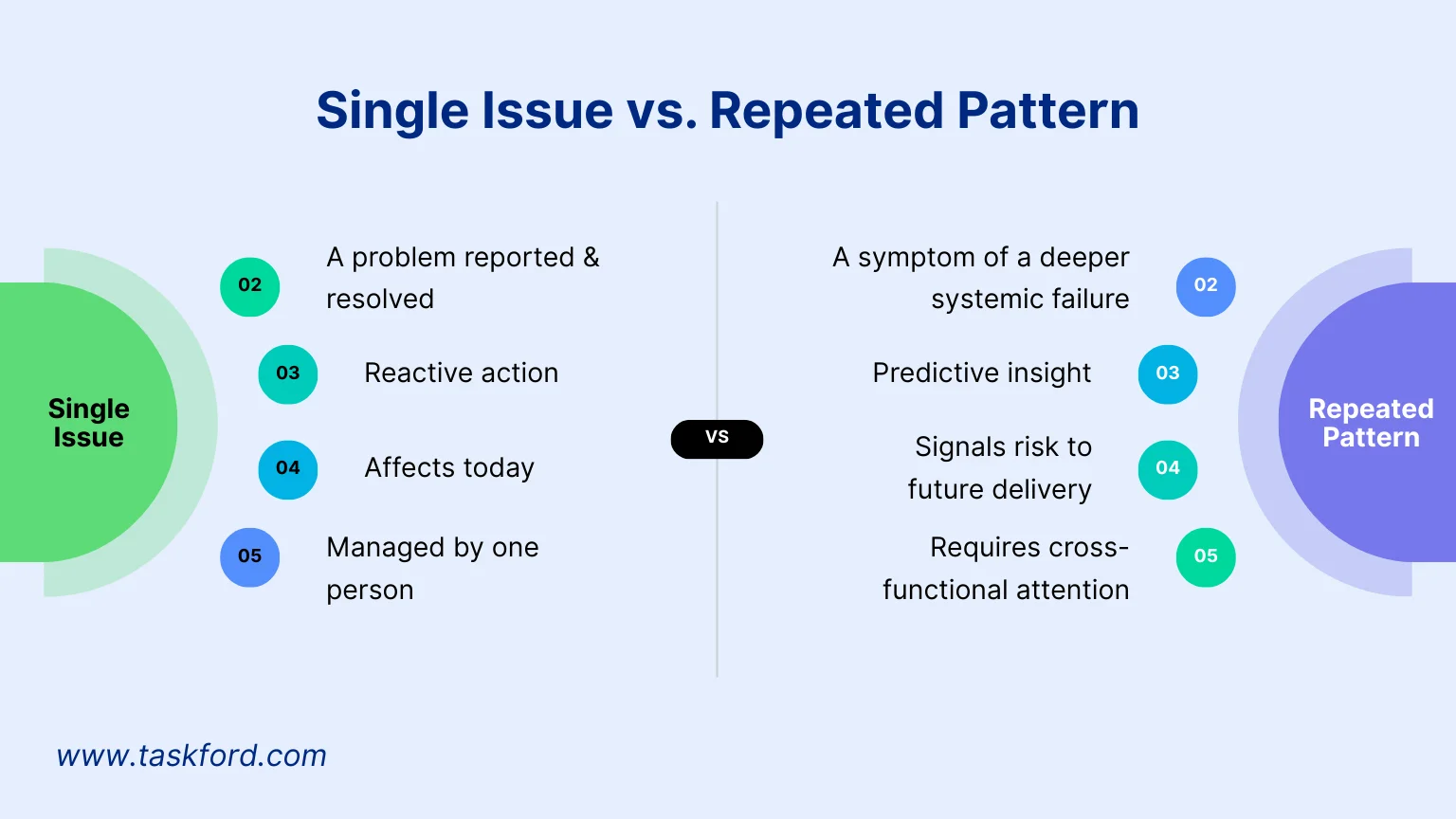
Most project teams focus on resolving issues one at a time. But seasoned project managers know that the true risk lies not in individual issues, but in the patterns and trends silently forming across multiple issue log entries. These patterns often expose underlying structural flaws, long before the project officially falls behind.
| Single Issue | Repeated Pattern |
|---|---|
| A problem reported and resolved | A symptom of a deeper systemic failure |
| Reactive action | Predictive insight |
| Affects today | Signals risk to future delivery |
| Managed by one person | Requires cross-functional attention |
Focusing only on isolated issue resolution is like treating symptoms without diagnosing the illness. Patterns reveal what’s recurring, escalating, or worsening over time, giving you the chance to intervene early and protect delivery confidence. This is particularly relevant when it comes to stakeholder dynamics. As highlighted in Harvard Business Review’s article, “3 Ways to Make All Your Stakeholders Feel Heard,” effective stakeholder engagement is crucial for early recognition of systemic issues and prevents problems from repeatedly resurfacing. When stakeholders actively participate in issue discussions, patterns are identified earlier, and corrective action is more strategic.
5 Hidden Patterns in Issue Logs That Predict Project Failure

While individual issues may seem manageable in isolation, patterns hidden within your issue log often provide early signals of deeper project vulnerabilities. Understanding these patterns can help you intervene before delays escalate, budgets expand, or stakeholder confidence declines.
1. Recurring Issues Assigned to the Same Department or Individual
When the same team or person repeatedly appears in issue ownership, it often signals capacity constraints, skill gaps, or unclear accountability lines. Over time, this pattern can highlight structural weaknesses in team distribution or poor task delegation.
What to track:
- Percent of issues assigned to each department over time
- Whether similar root causes reappear (e.g., “incomplete specs”, “deployment errors”)
If the same owner appears in >30% of unresolved issues, it may indicate a resource or process problem, not a performance issue.
2. Repeated Delays in Resolution for Critical Issues
Delayed resolution of high-priority issues is one of the strongest predictors of project overruns. It often reflects bottlenecks in decision-making, poor escalation protocols, or insufficient stakeholder alignment.
Watch for:
- Critical issues missing their target resolution date more than once
- Extended silence periods between updates
An issue that remains open beyond two reporting cycles is likely blocking key project milestones.
3. More Issues Raised Late in the Project Lifecycle
If the volume of new issues spikes during later project phases (e.g., testing, implementation), it often indicates insufficient planning, inadequate requirements validation, or poor early-stage quality control.
Predictive indicator:
- 40% of total issues raised after the execution phase = potential project rework or delay
The later issues surface, the more expensive they are to fix.
4. High Number of “Reopened” or “Reoccurring” Issues
Recurring or reopened issues show that teams are applying temporary fixes rather than solving underlying root causes. This pattern is commonly linked to technical debt in IT projects or incorrect risk prioritization in large initiatives.
What to review:
- Issues with a status history of “Closed → Reopened”
- Number of times issues reference a similar problem
A high reopen rate suggests your team is firefighting instead of resolving.
5. Increased Issue Severity Score Over Time
When severity increases consistently, it signals that management is reacting late or that the project is entering critical phases without adequate risk mitigation. Severity escalation often precedes executive escalation and scope compromise.
What to monitor:
- Severity trend (e.g., Medium → High over 2 reporting cycles)
- Average severity score per sprint or milestone
A rising severity trend is more alarming than the volume of issues—it suggests worsening impact.
Best Practices for Identifying Issue Log Patterns Early
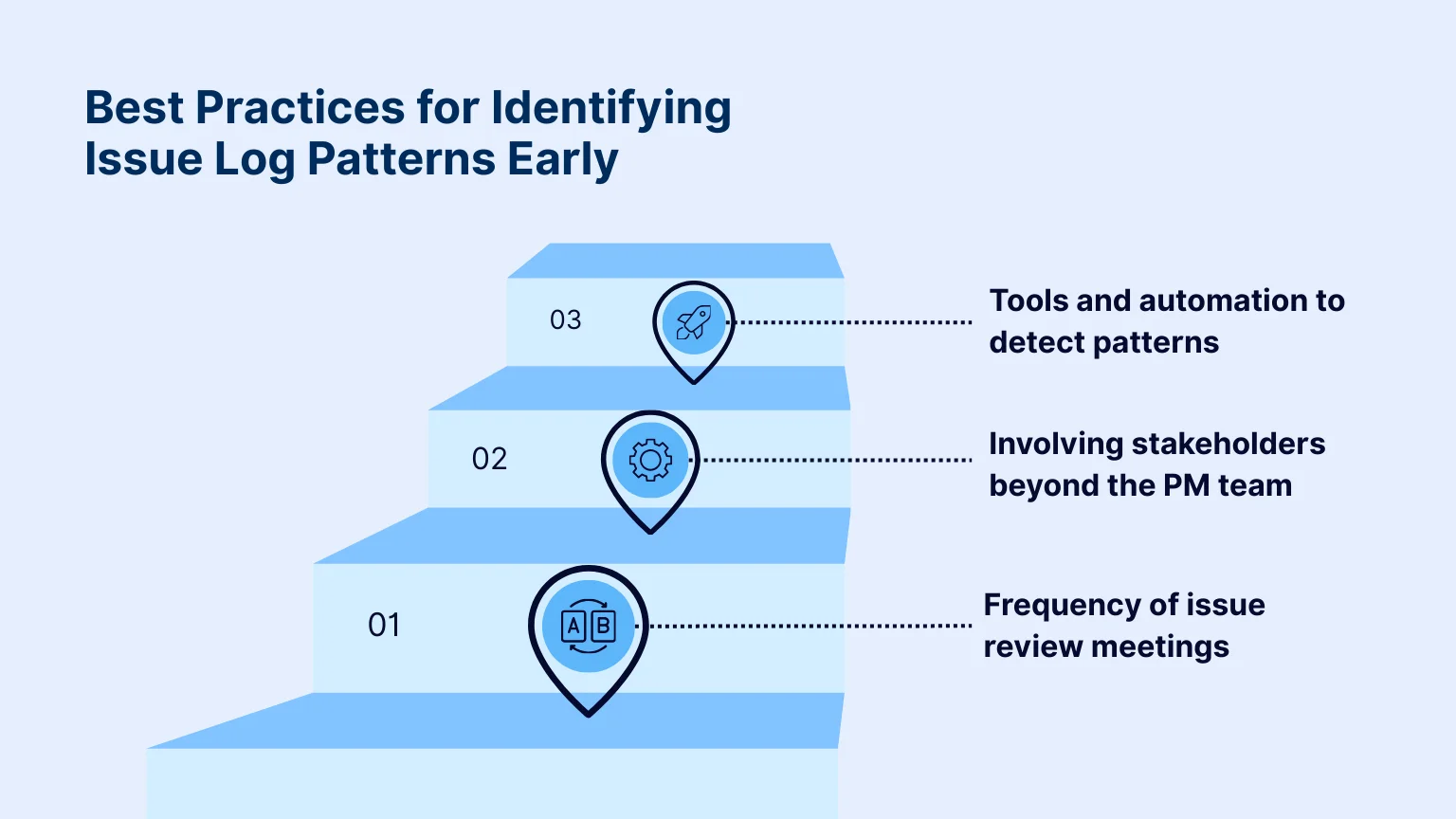
To detect potential project risks before they escalate, issue logs must be reviewed proactively rather than reactively. Early identification of patterns comes from consistent monitoring, collaborative evaluation, and smart automation—not just tracking individual issues.
1. Frequency of issue review meetings
Instead of relying solely on weekly updates, project managers should assess issues more frequently during high-impact phases such as testing or pre-launch stages. Integrating pattern analysis into sprint reviews or milestone checkpoints helps uncover trends before they become critical.
2. Involving stakeholders beyond the PM team
Issue pattern detection is more effective when technical leads, business analysts, QA teams, and even project sponsors contribute to the review process. Their input ensures issues are understood at a systemic level rather than resolved superficially, reducing the chances of recurrence.
3. Tools and automation to detect patterns
Manual tracking often misses early warning signals. Automated platforms and analytics dashboards enable teams to monitor issue severity, resolution delays, and recurrence trends in real time. Using predictive tools helps identify risks sooner and supports data-driven project decisions.
Final Thoughts
Most project managers view an issue log as a compliance document or progress tracker. But when analyzed properly, it becomes one of your most powerful predictive project intelligence tools. The real value lies not in listing problems, but in recognizing warning patterns that quietly signal risk long before failure becomes visible.
Projects rarely collapse due to a single critical issue. They fail because small concerns are repeatedly raised, ignored, or temporarily resolved without strategic intervention. When you consistently track ownership trends, resolution delays, issue recurrence, late-stage emergence, and severity escalation, you shift from reactive management to proactive leadership.
The PMs who succeed are not the ones who resolve issues fastest. They’re the ones who detect patterns earliest. As you review your next issue log, ask yourself:
- “What’s this really telling me about the future of this project?”
- “Is this a one-off problem, or a symptom of something systemic?”
By leveraging issue pattern insights, you don’t just manage projects, you steer them with foresight.
Subscribe for Expert Tips
Unlock expert insights and stay ahead with TaskFord. Sign up now to receive valuable tips, strategies, and updates directly in your inbox.