Principles of Accurate Forecasting in Project Management
Learn the important principles, methods, and metrics of accurate forecasting in project management to improve planning, risk management, and delivery outcomes.
Accurate forecasting is a foundational discipline in modern project management. It supports planning, funding decisions, risk mitigation, sequencing, capacity planning, and delivery confidence. Forecasting is not a guessing exercise or a contractual promise. It is a structured, evidence-informed projection of future outcomes based on what is known now, combined with assumptions about what may happen later. In best practice organisations, forecasting is treated as a continuous learning cycle rather than a one-time statement.
This article explains what forecasting means, explores the main forecasting methods, shows how to choose the appropriate method, and then dives into the advanced principles that create reliable, repeatable, and decision-ready forecasts.
Definition of Forecasting in Project Management
Forecasting is the practice of estimating future project outcomes such as delivery timelines, cost levels, resource requirements, or progress milestones through a structured combination of data, expert insight, and contextual analysis. It starts at project initiation to shape scope clarity and planning paths, then continues through the full delivery lifecycle to maintain directional correctness.
A forecast should always be:
- Evidence informed rather than speculative
- Probabilistic rather than absolute
- Updated periodically rather than static
- Supported by assumptions and confidence levels
- Presented to enable decision making
In short: a forecast helps teams and leaders make better choices with imperfect information.
Forecasting Methods
Forecasting methods fall into two main categories: qualitative and quantitative. Qualitative methods rely on expert insight. Quantitative methods rely on data. Both are valid depending on project maturity, clarity, and available information.
Qualitative Forecasting
Qualitative forecasting uses expert judgment, contextual understanding, and professional interpretation. It works best during project initiation or when a project is too new or unique to have reliable historical data.
Expert judgment
This method gathers predictions from people who have deep knowledge of the domain. Their past experience with similar work helps them detect hidden complexity, estimate effort, and flag risks that numbers alone cannot reveal.
Use it when:
- The project is new or ambiguous
- You need directional insight fast
- You lack reliable performance data
Historical analogy
Historical analogy compares the current project to previous ones. If an earlier project with similar complexity required eight weeks, that timeframe becomes a reasonable starting point. This method works best when the comparison is truly relevant and the conditions are similar.
Delphi method
The Delphi method collects multiple expert opinions through several rounds. After each round, the experts review anonymized results and adjust their predictions. This avoids bias from senior voices or dominant personalities.
Use it when:
- The topic is high risk
- The team needs consensus
- You want structured judgment instead of guesswork
Scenario forecasting
Scenario forecasting explores several possible futures. Instead of searching for one correct answer, the team examines a best case, realistic case, and challenging case. This approach prepares stakeholders for uncertainty.
Quantitative Forecasting
Quantitative forecasting uses numerical data, performance metrics, and measurable patterns. It works best when you have consistent historical data and stable delivery patterns.
Trend analysis
Trend analysis looks at past performance to identify patterns that are likely to continue. For example, if a team delivers eight story points per week consistently, that trend can help forecast future sprints or cycles.
It’s good for:
- Predicting future throughput
- Understanding budget or effort growth
- Identifying patterns in delivery performance
Time series analysis
Time series analysis uses data collected at regular intervals, such as weekly cycle time or monthly burn rate. Over time, you can detect trends, seasonality, and workload fluctuations.
This forecasting method is essential for:
- Long term capacity forecasting
- Spotting recurring workload peaks
- Estimating delivery timelines based on stable patterns
Moving averages
A moving average smooths out random fluctuations by averaging data across a set period. This reveals the underlying direction of the project and is helpful for short term predictions when performance varies from week to week.
Exponential smoothing
Exponential smoothing gives more weight to recent performance data. This makes the forecast more responsive to new changes in team behavior, resource availability, or unexpected disruptions.
Regression analysis
Regression analysis identifies relationships between variables and uses them to forecast outcomes. For example, it can show how adding two more developers may reduce cycle time or how rising task complexity affects delivery speed. It is one of the strongest methods for understanding cause and effect in project management.
Powerful for:
- Predicting performance based on resource changes
- Understanding cause and effect
- Forecasting the impact of workload or scope adjustments
How to Choose the Right Forecasting Method
Selecting the right method prevents both over-engineering and shallow estimation. Use the following decision logic:
| Situation | Recommended Approach |
|---|---|
| No measurable historical data | Qualitative |
| Novel, exploratory, or R&D work | Qualitative |
| Repetitive work with stable metrics | Quantitative |
| Mixed clarity, partial data | Hybrid |
| Urgent directional decision needed | Qualitative first, refine later |
| High-risk or high-budget initiative | Hybrid as default |
Additional selection criteria
Ask these questions before choosing:
- Is the work similar to something previously delivered?
- Do we have reliable delivery metrics?
- Are external dependencies a major factor?
- How soon do decisions need to be made?
- Is leadership comfortable using ranges rather than single dates?
If clarity, repeatability, and data maturity are all low, qualitative forecasting is most appropriate. If they are high, move toward quantitative forecasting. If they are mixed, default to hybrid.
Principles of Accurate Forecasting
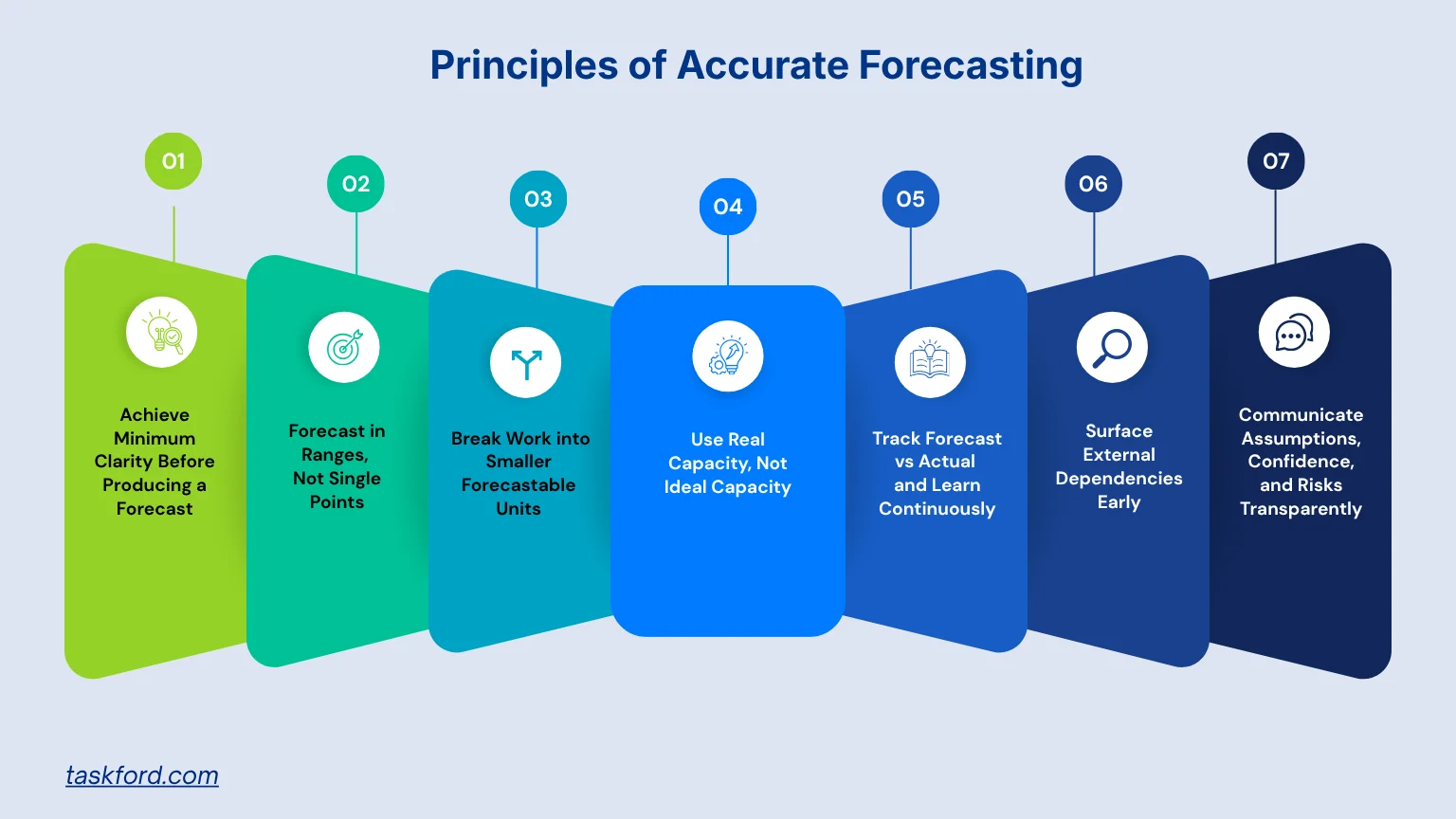
These principles raise forecasting from simple estimation into a professional management discipline.
Principle 1: Achieve Minimum Problem Clarity Before Producing a Forecast
A significant percentage of failed forecasts originate from unclear scope, missing constraints, or unrecognised dependencies. Before forecasting, teams should define:
- What is inside and outside scope
- Expected quality criteria
- Delivery constraints and assumptions
- Internal and external dependencies
If these are unclear, mark the first forecast as directional only and schedule a refinement milestone.
Principle 2: Forecast in Ranges, Not Single Points
Single-number predictions imply certainty that rarely exists in complex work. Use reasonably bounded ranges that include a confidence level and conditions.
Examples:
- “Estimated delivery: 8 to 12 weeks, 70 percent confidence.”
- “Cost projection: 120k to 150k depending on vendor lead times.”
Ranges educate project stakeholders on uncertainty and improve trust because they prevent false commitments.
Principle 3: Break Work into Smaller Forecastable Units
Granularity increases predictability. Smaller work units reduce hidden complexity and allow rolling recalibration. In order to break work into smaller units:
- Tasks should ideally be forecastable in short cycles
- Decomposition should stop once each unit is independently deliverable
- Track completion patterns to identify outlier work types
If work cannot be decomposed, it signals a lack of clarity rather than a need for more estimation skill.
Principle 4: Use Real Capacity, Not Ideal Capacity
Teams often assume a full-time working week. In reality, productive delivery time is constrained by meetings, context switching, maintenance, incident response, and unplanned tasks. To calculate real capacity:
- Measure actual productive hours over several cycles
- Apply a utilization factor (example: 65 to 75 percent for knowledge workers)
- Model using the lower value to maintain realism
This protects psychological safety and avoids unsustainable commitments.
Principle 5: Track Forecast vs Actual and Learn Continuously
Forecasting accuracy improves only when variance is examined without blame. Continuous learning approach can:
- Capture original assumptions
- Record actual outcomes
- Identify deviation sources
- Adjust future models accordingly
A short monthly “forecast accuracy retrospective” can improve organisational maturity faster than purchasing complex tools.
Principle 6: Surface External Dependencies Early and Explicitly
Project dependencies are one of the most common causes of schedule slippage. They must be visible, owned, and continuously monitored.
Recommendations:
- Track dependency owner, date, and lead time
- Add buffers for external parties
- Use verified rather than assumed commitment dates
- Prototype or test integrations early
If a dependency is critical, management escalation pathways must be agreed before work begins.
Principle 7: Communicate Assumptions, Confidence, and Risks Transparently
A forecast without context creates misalignment. A strong forecast communication pack includes:
- Range estimate
- Confidence level
- Governing assumptions
- Top three risks
- Internal and external dependencies
- Next review checkpoint
The goal is not to share data, but to support informed business decisions.
Benefits of Accurate Forecasting
When forecasting becomes a disciplined practice, teams and organisations gain measurable advantages:
- Better project initiation clarity: Forecasting strengthens early planning by grounding estimates in evidence instead of assumptions. This helps teams define scope, effort, and constraints with higher confidence.
- Stronger resource management decisions: When future workloads are visible, managers can allocate people, skills, and budgets more intelligently. This reduces overload, idle time, and last-minute reshuffling.
- Earlier detection of delivery risks: Forecasting highlights upcoming schedule pressure, budget variance, or capacity gaps before they escalate. Teams gain more time to replan or negotiate trade-offs.
- More reliable stakeholder communication: Consistent forecast updates create predictable expectations for sponsors and clients. This increases trust because changes are explained with clear data, not guesswork.
- Higher probability of delivering on time and within constraints: Projects that refine forecasts continuously are less likely to drift. Forecasting becomes a feedback loop that keeps execution aligned with planned goals.
- Better prioritization across the portfolio: Organizations can compare forecasted impact, effort, and risk across initiatives, making smarter choices about what to start, pause, or accelerate.
Forecasting is therefore both a technical practice and a leadership communication function.
Metrics That Improve Forecasting Quality
Useful metrics keep forecasting grounded. With these metrics, you can have more accurate forecasting. The metrics include:
- Forecast accuracy ratio: Shows the proportion of planned work completed within the expected timeframe or cost. A higher ratio indicates that your forecasting assumptions match actual project performance.
- Schedule variance: Measures the difference between planned progress and actual progress. It helps identify whether the team is ahead, behind, or exactly on track according to the forecast.
- Average cycle time or lead time: Captures how long tasks or work items typically take from start to finish. Stable cycle times make quantitative forecasting more reliable because future tasks are more predictable.
- Work-in-progress stability: Indicates whether the team is handling a consistent number of active tasks. Too much variation suggests bottlenecks and weakens the reliability of future predictions.
- Scope change frequency: Tracks how often requirements, tasks, or deliverables change. High levels of change signal uncertain environments where forecasts must be updated more frequently.
- Throughput stability: Shows how consistently the team completes work over time. Steady throughput is a strong indicator that forecasts based on historical data will hold up under real conditions.
Metrics must not be weaponised; they are learning tools, not performance punishment tools. Understanding these metrics will give you a more in-depth look into your projects and correct prediction in the future.
Conclusion
Forecasting is not about predicting the future with perfect accuracy. It is about providing the most informed and transparent view possible, based on current knowledge, structured methods, and disciplined review. When applied correctly, forecasting shifts project management from reactive schedule reporting into proactive decision enablement.
A strong forecasting culture accepts uncertainty, measures reality, communicates transparently, and adjusts quickly. That is the foundation of modern, confident delivery.
Learn more
- Agile Capacity Planning: How to Match Team Velocity with Real-World Workloads
- How Workforce Capacity Planning Helps You Say “Yes” to the Right Work
- Crafting a Resource Management Plan: A Project Manager’s Handbook
Subscribe for Expert Tips
Unlock expert insights and stay ahead with TaskFord. Sign up now to receive valuable tips, strategies, and updates directly in your inbox.